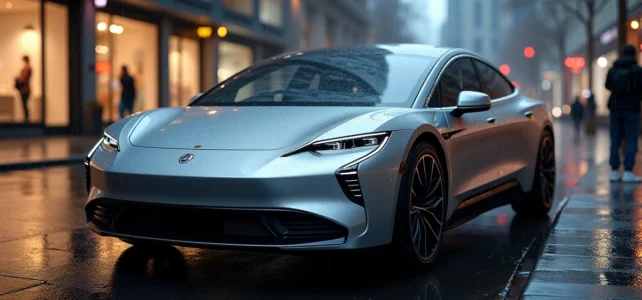
On a thirty-kilometer commute, you now encounter as many hybrid SUVs as diesel sedans. This silent shift encapsulates what is happening in the automotive world in 2024: powertrains are changing, public subsidies are guiding purchases, and manufacturers are adapting their ranges under European regulatory pressure. The French market illustrates these tensions better than any auto show.
GSR2 Regulation: What Manufacturers Are Already Integrating into New Models
Before discussing models or powertrains, it is essential to understand what will become mandatory. The European GSR2 regulation stipulates that starting July 7, 2026, three driver assistance systems will be required on all new cars sold in Europe.
The first is a driver attention monitoring system via a camera, capable of triggering close-range audible alerts if the driver’s gaze leaves the road for too long. The second, called the emergency stop signal (ESS), makes the brake lights flash during sudden braking above 50 km/h to warn following vehicles. The third combines the detection of cyclists and pedestrians with automatic emergency braking.
In practice, most models launched or refreshed in 2024-2025 already include these technologies, at least as options. Here you can find the latest auto news on Scooporama detailing standard equipment by model, which helps compare before making a purchase. Manufacturers anticipating this deadline avoid having to recall or modify their vehicles at the last minute.
For buyers, the direct consequence is a mechanical increase in entry-level prices. The cheapest models now include sensors and cameras that did not exist three years ago. This additional cost is partially offset by the price reductions observed in certain segments after five years of uninterrupted increases.
Electric Vehicles in France: Market Share Grows, Total Volume Declines
It is often said that electric vehicles are booming. The reality on the ground is more nuanced. Registrations of new passenger cars decreased in 2025 compared to 2024, even as the share of electric vehicles reaches a record level, close to one in five new vehicles.
This growth heavily relies on public subsidies. In 2024, 83% of households purchasing a new electric car benefited from at least one subsidy (environmental bonus, conversion premium, or social leasing), totaling €1.25 billion paid by the state.
Three Points to Check Before Going Electric
- Daily access to a charging station: without charging at home or work, the cost and time spent at public chargers can negate the economic advantage of an electric vehicle
- Eligibility for subsidies: criteria change every year, and some models assembled outside Europe lose their bonus, which alters the calculation of the actual cost
- Actual usage in kilometers: for trips regularly exceeding 300 kilometers without a stop, feedback varies on the reliability of the range estimates displayed by manufacturers
The used electric vehicle market is still poorly structured. Batteries age differently depending on models and usage conditions, complicating the evaluation of a second-hand vehicle without specific technical diagnostics.
Hybrids and Combustion Engines: Why the Market Isn’t Shifting as Quickly as Announced
On the ground, there is a growing interest in mild hybrids and plug-in hybrids. For many drivers, hybrids remain the most realistic compromise between budget constraints and energy transition. A combustion engine coupled with electric assistance allows for reduced consumption in the city without relying on a network of charging stations.
Pure combustion engines, however, are not disappearing. Gasoline and diesel powertrains still represent the majority of sales in France. Buyers who drive a lot on highways or tow trailers find it challenging to find an electric or hybrid equivalent at the same price with the same versatility.
Manufacturers are therefore maintaining updated combustion ranges, particularly for utility vehicles and compact SUVs. This coexistence of powertrains complicates the choice at dealerships, but it reflects the real diversity of uses.
Prices of New Cars: A Shift After Five Years of Increases
After five consecutive years of price increases, the prices of new cars are starting to decline in France in certain segments. Several factors explain this turnaround.
The competitive pressure from Chinese manufacturers, who offer electric vehicles at aggressive prices, is pushing European brands to reposition their pricing structures. At the same time, the gradual decrease in the cost of lithium-ion batteries allows for a reduction in the production cost of electric models without cutting into margins.
- Entry-level electric city cars are becoming accessible to a broader audience thanks to a combination of price reductions and public subsidies
- Compact SUVs, the best-selling segment, are seeing their prices stabilize after years of inflation
- The used market is also benefiting from this easing, with an influx of recent vehicles from lease returns
For a buyer hesitating between new and used, the question is no longer just the displayed price but the total cost of ownership over three to five years, including insurance, energy, and maintenance. In this overall calculation, electric vehicles become competitive for urban profiles with low annual mileage.
The automotive world in 2024 is not just a race between powertrains. European regulatory obligations, the structure of public subsidies, and price evolution shape a market where each purchase requires more careful analysis than before. Comparing actual costs, checking eligibility for subsidies, and anticipating which features will become standard remains the most reliable method for making a choice suited to daily use.