
Vendée concentrates a significant share of the camping and residential leisure park offerings in France. This Atlantic coastline attracts buyers every year tempted by the purchase of a mobile home on a plot, but the legal framework and local business practices deserve careful examination before signing anything.
PPRI coastal in Vendée: a regulatory constraint to verify plot by plot
Since the generalization of Flood Risk Prevention Plans along the Atlantic coast, several Vendée municipalities classify camping areas as flood-prone (blue or red zones). This classification, which can be consulted at the prefecture or on the department’s website, concretely limits the annual occupancy duration of mobile leisure homes, even in campgrounds with permanent operating permits.
A campground can obtain a permanent operating permit while being partially located in a PPRI zone. In this case, certain plots are subject to a winter occupancy ban or evacuation obligations in case of weather alerts. Buyers considering the purchase of a plot for a mobile home in Vendée must verify the exact zoning of the targeted location, plot by plot, and not rely solely on the manager’s mention of “open year-round.”
This verification radically alters the profitability calculation. A plot that can be occupied for eight months a year does not generate the same savings as permanent use, and reselling a mobile home on a location constrained by the PPRI proves to be significantly more difficult.

Plot contract in Vendée camping: what is negotiable and what is not
The purchase of a mobile home in a campground is based on a simple legal dissociation: you own the mobile home, not the land. The land is subject to a location rental contract, usually annual and renewable.
Transferability clauses of the contract
Specialized actors report an increasingly marked trend on the Vendée coastline: the plot rental contract is not freely transferable when reselling the mobile home. The campground manager can refuse the transfer, renegotiate the rent upwards, or impose new conditions on the future buyer.
This clause, often buried in the general conditions, significantly reduces the liquidity of your property. A mobile home whose plot contract is not transferable is mechanically worth less upon resale because the potential buyer must obtain the campground’s agreement and accept its new pricing conditions.
Increase in rents and ancillary charges
Several investment guides note a significant increase in plot rents along the Vendée coastline in recent years. Ancillary charges (water, electricity, maintenance of common areas, tourist tax) follow the same trajectory. The actual annual budget often exceeds just the rent displayed in the sales brochure.
Before signing, request a detailed breakdown of charges for the last three years and check if the contract includes a cap on annual rent increases. The absence of a cap exposes you to price revisions without recourse.
PRL or camping: two legal statuses, two property realities
The distinction between residential leisure park (PRL) and classic campground conditions the very nature of your acquisition. In PRL, you can own the plot, not just the mobile home. It is the only arrangement where the buyer truly controls their land investment.
In camping, the land remains the property of the manager. Your mobile home depreciates over time (the depreciation can reach several dozen percent in the first years, according to available sources), and you remain dependent on the renewal of the location contract. Field reports vary on this point: some managers renew without difficulty for decades, while others impose the replacement of the mobile home beyond a certain age.
- In PRL with plot purchase, you have a title of ownership on the land, transferable and resalable freely.
- In PRL with plot rental, the operation is similar to that of a campground, with a longer lease (often multi-year).
- In camping, the renewable annual contract places you in the position of a tenant of the land, with no guarantee of long-term maintenance.
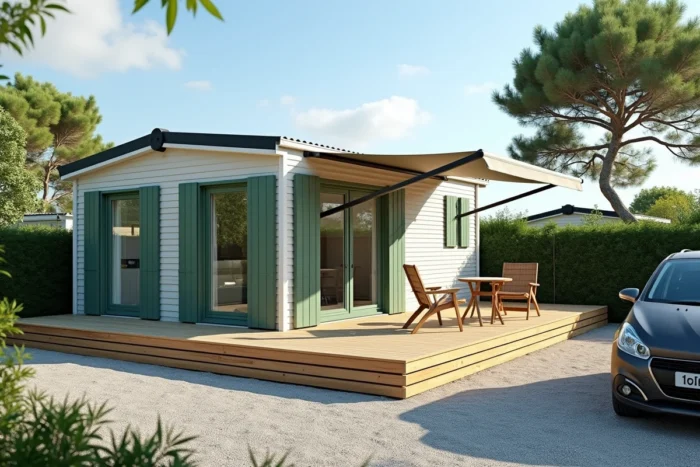
Non-buildable private land in Vendée: the prohibition of year-round living
The idea of installing a mobile home on non-buildable private land regularly comes up in searches. The regulation is clear: living in a mobile home year-round on non-buildable private land is prohibited. The penalties, calculated per square meter, can represent a dissuasive amount.
Temporary installation (less than three months per year) remains possible under conditions, but it excludes any project for a primary or semi-permanent residence. Leisure plots sold on real estate platforms do not confer the right to live there, even on a prolonged seasonal basis.
Verification points before any commitment in Vendée
- Consult the PPRI zoning of the municipality and verify the exact classification of the targeted plot with the prefecture.
- Read the entire location rental contract, paying particular attention to transferability clauses, maximum duration of the mobile home, and rent capping.
- Compare the total annual cost (rent, charges, insurance, maintenance) over three rolling years, not just the purchase price of the mobile home.
- Verify the exact legal status of the establishment (classified campground, PRL transfer, PRL rental) and its consequences on land ownership.
The Vendée mobile home market on plots remains active, driven by the tourist appeal of the coastline. Prices and profitability vary greatly from one location to another, depending on the contract offered and the manager. The only constant is the information asymmetry between the campground manager and the buyer, which only a methodical verification, document by document, can help to rebalance.