
Choosing your engine oil is not just about buying the cheapest can in the auto aisle. The viscosity grade, technical standards, and manufacturer recommendations form a trio of criteria that, if misunderstood, can accelerate engine wear or compromise its pollution control system. The market has evolved in recent years with the emergence of very low viscosity grades and more demanding certifications, making the choice less intuitive than before.
API SP and ILSAC GF-6 Standards: What Has Changed for Recent Engines
Most online guides still mention the API SN standard as a reference for gasoline engines. Since 2020, the API SP certification and the ILSAC GF-6 standard have taken over. These two standards include specific tests against low-speed pre-ignition (LSPI), a phenomenon that particularly affects turbo direct injection engines.
LSPI causes uncontrolled pressure spikes in the combustion chamber, which can damage the pistons. Oils certified API SP contain additives formulated to limit this risk. They are also tested for wear on the timing chain and compatibility with modern pollution control systems (particulate filters, catalysts).
To find out how to choose your engine oil correctly, checking for the API SP or ILSAC GF-6 mention on the can is a reliable first filter, especially if your vehicle is a turbo SUV or a recent gasoline city car.
Viscosity Grade: Why the Maintenance Book Takes Precedence Over Habit

The SAE viscosity grade, expressed in the form 0W-20 or 5W-30, indicates the oil’s behavior when cold (the number before the W) and when hot (the number after). A low cold grade ensures quick lubrication at startup, which is when most mechanical wear occurs.
The current trend is towards very low viscosity oils like 0W-20 or 0W-16. Manufacturers require them for engines optimized to reduce CO2 emissions: the less viscous the oil, the less energy the engine spends to circulate it. Using a thicker oil than recommended (for example, 5W-40 instead of 0W-20) can increase fuel consumption and distort the operation of pollution control systems.
On the other hand, for an older engine designed for 15W-40, switching to an oil that is too fluid risks causing leaks at seals that are not sized for that viscosity. The manufacturer’s maintenance book remains the only reliable reference for determining the appropriate grade.
Viscosity and Climate: A Nuance Often Overestimated
Field reports vary on this point. In temperate European climates, the difference in behavior between a 0W and a 5W at startup remains marginal for most drivers. The climate issue becomes truly significant in regions where temperatures regularly drop below -20 °C, where a 0W grade measurably facilitates cold starting.
ACEA Standards and Manufacturer Approvals: Two Distinct Levels of Reading
ACEA standards (European Automobile Manufacturers Association) classify oils by categories according to the type of engine and performance level. Categories C (C1, C2, C3, C4, C5) target vehicles equipped with exhaust after-treatment devices, such as diesel or gasoline particulate filters.
An oil not compatible with ACEA C can clog a particulate filter in just a few tens of thousands of kilometers. C category oils contain less sulfated ash (known as “Low SAPS”), which preserves the lifespan of the filter. Choosing a standard oil for a vehicle equipped with a DPF is akin to saving on the can only to risk a much heavier replacement bill for the filter.
Beyond the ACEA standard, some manufacturers require their own specific approvals. For example, Volkswagen uses codes VW 504.00/507.00, while Mercedes-Benz has its own MB 229.51 or 229.71 sheets. These approvals impose additional tests that the ACEA standard alone does not cover.
- Check the ACEA standard on the can (A3/B4, C3, C5, etc.) and compare it to the one indicated in the maintenance book
- Look for the specific manufacturer approval if your brand requires one (often printed on the back of the can)
- Do not confuse “compliant with” and “approved by”: the first formulation means that the oil meets the specifications without having been officially tested by the manufacturer
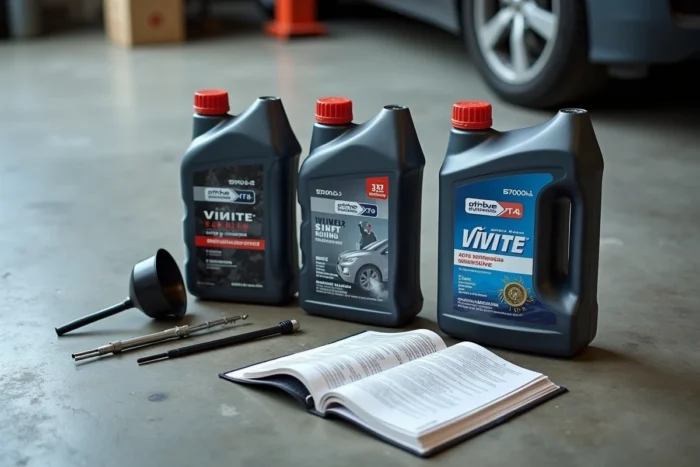
Synthetic, Semi-Synthetic, or Mineral Oil: A Choice Related to the Engine, Not the Budget
Synthetic oils dominate the market for modern vehicles. Their homogeneous molecular structure provides better thermal stability and increased resistance to oxidation. Recent engines, with their tight mechanical tolerances and extended oil change intervals, are designed to operate with this type of lubricant.
Mineral oils, derived from the direct refining of petroleum, remain suitable for older engines that do not require very fluid grades. Using a 15W-40 mineral oil on a well-maintained older engine poses no problem and often corresponds to the original recommendation.
Semi-synthetic oils (typically in 10W-40) occupy an intermediate segment. They are suitable for engines that do not require very low grades but benefit from better performance than pure mineral oils, especially in urban cycles with frequent cold starts.
Oil Change Intervals and Oil Quality
Recommended intervals vary by engine type: gasoline engines generally have more frequent oil changes than diesels over long distances. Predominantly urban driving, with short trips that do not allow the oil to reach its optimal temperature, degrades the lubricant faster. Adjusting the oil change frequency to actual usage is as important as choosing the grade.
The choice of engine oil relies on three concrete checks: the viscosity grade recommended by the manufacturer, the ACEA standard compatible with the vehicle’s pollution control system, and the API certification or specific manufacturer approval. These three elements are listed in the maintenance book. Ignoring them in favor of price or habit exposes the engine to premature wear that the driver will not detect for several years.