
A rolled mattress does not load like a box of books. Its weight, deformability, and rebound potential during braking pose constraints that most moving guides overlook. Here, we detail the technical points to master for car transport without degrading either the mattress or the vehicle’s handling.
Maximum admissible weight: the forgotten criterion for transporting mattresses in a car
Before measuring if the mattress fits in the trunk, we recommend checking the maximum technically admissible weight listed on the registration document (item F.2). This value includes the weight of the vehicle when empty, passengers, and all the cargo.
A high-density foam or solid latex mattress weighs significantly more than an entry-level model. Add the weight of the driver, a potential passenger, and luggage: the remaining margin may be smaller than one might imagine, especially in a segment B vehicle.
Exceeding this limit alters the rear ride height, increases braking distances, and may engage your liability in case of a check or accident. Find more transport tips on Idylle Habitat to delve deeper into this often-ignored point.
Rolled mattress in the cabin: immobilization and road safety
A compressed and rolled mattress remains a bulky and soft object. In the event of sudden braking, it behaves like a projectile with an unpredictable trajectory if not secured properly.
Positioning against the backrest
The basic rule for car loading is to place heavy masses as low and as close to the rear backrest as possible. The rolled mattress should rest on the trunk floor, wedged against the folded bench seat. This position lowers the center of gravity and limits lateral displacement during turns.
Straps and retention net
Short ratchet straps (textile tie-down type) keep the roll compressed and prevent it from sliding. A separation net between the trunk and cabin adds a physical barrier between the cargo and the occupants.

- Pass at least two perpendicular straps around the roll to prevent it from partially unrolling during the journey.
- Secure the straps to the trunk’s anchor points (metal rings) rather than to the headrests, which are not designed to hold a load.
- If the mattress extends into the cabin after folding the seats, no passenger should sit in the back: the space is reserved for the cargo.
Rolling a spring or latex mattress: technical limits of rolling
Rolling is suitable for polyurethane and memory foam mattresses, designed to withstand temporary compression. However, a pocket spring mattress should never be rolled: the mechanical stress deforms the springs and irreversibly compromises support.
For solid latex, the situation depends on the manufacturer. Some high-density natural latex blocks tolerate brief rolling, while others do not. We recommend checking the product sheet or contacting customer service before any handling. Unapproved rolling may void the warranty.
Duration of compression: a critical factor
Even on a compatible mattress, the duration it remains compressed matters. Manufacturer recommendations converge: unpack the mattress as soon as it arrives and allow it to regain its shape. Full recovery may take several days depending on the foam technology used.
Leaving a rolled mattress for an extended period without manufacturer validation risks creating areas of permanent compression, especially on low-resilience foams.
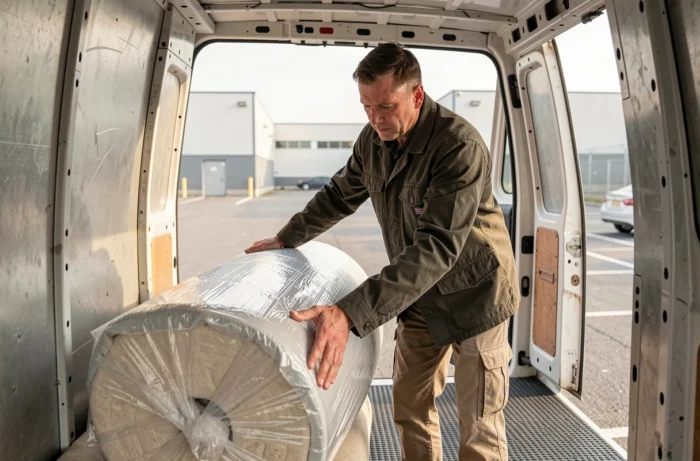
Protecting the mattress during car transport
Rolling exposes the mattress cover to friction against the trunk floor, seat rails, and interior walls. A dedicated protective cover (made of thick plastic or non-woven textile) prevents snags, grease stains, and residual moisture from the trunk.
- Slip the cover on before rolling the mattress: it will be included in the roll and stay in place throughout the journey.
- If a cover is unavailable, a tarp secured with wide adhesive tape (like duct tape) protects against dirt, although it does not offer the same tear resistance.
- Avoid thin food stretch film, which tears at the first contact with a metal edge and only protects against dust.
Checks after unloading the mattress
Once the mattress is unrolled and laid flat on its foundation, visually inspect the surface for any localized deformations. On a memory foam model, a temporary indentation in the most compressed area is normal and will disappear as it regains its shape.
If a deformation persists beyond the time indicated by the manufacturer, document it with dated photos. This type of post-transport defect may fall under warranty, provided you can prove that the rolling adhered to the original recommendations.
The most underestimated point remains ventilation. A mattress that has spent several hours compressed in a closed trunk accumulates moisture. Leave it in an airy room, without sheets or duvet, for at least a full day before first use.