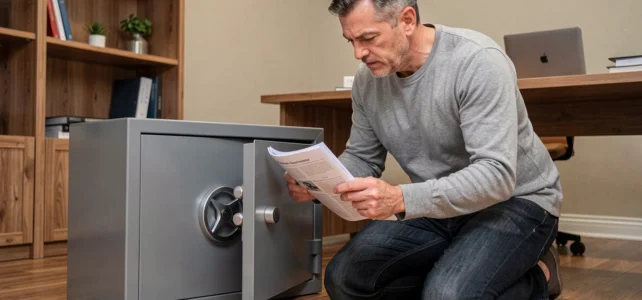
A safe fixed to the floor with through bolts and anchor rods embedded in the concrete resists pulling out much better than a model simply placed on a shelf. Floor fixation transforms a metal box into an integral part of the building’s structure, which radically changes the time required for a burglar to extract it.
However, it is essential to choose the right fixing method according to the type of flooring, the level of coverage required by the insurer, and one’s own ability to drill into concrete.
Concrete floor, wooden floor, or tiles: adapting the fixation to the support
Not all floors are equal when it comes to anchoring with mechanical or chemical anchors. A solid concrete slab offers the best resistance to pulling out. Metal expansion anchors perform optimally in it, and chemical anchoring (polyester or epoxy resin) hardens without difficulty.
On a wooden floor laid on joists, the situation is different. Wood alone does not hold an expansion anchor with the same strength as a mineral slab. One must drill through the floor to reach the screed or load-bearing slab below, or fix the safe to a metal base bolted directly into the joists. Without this precaution, a lever is enough to pull the whole thing out.
Tiles present an intermediate problem. Porcelain stoneware is hard but brittle: drilling too quickly or with an unsuitable bit can crack the tile around the fixation point. A diamond bit at low speed, without percussion, goes through the tile cleanly. The actual fixation is then made in the screed or slab under the tiles.
Before choosing a safe to fix to the floor, it is necessary to identify the exact nature of the load-bearing support, not just the visible covering.
Floor fixation, wall anchoring, or buried safe: three levels of resistance
These three options are often presented as equivalent. They are not, neither in resistance to burglary, nor in installation complexity, nor in insurance requirements.
Anchoring to a concrete slab
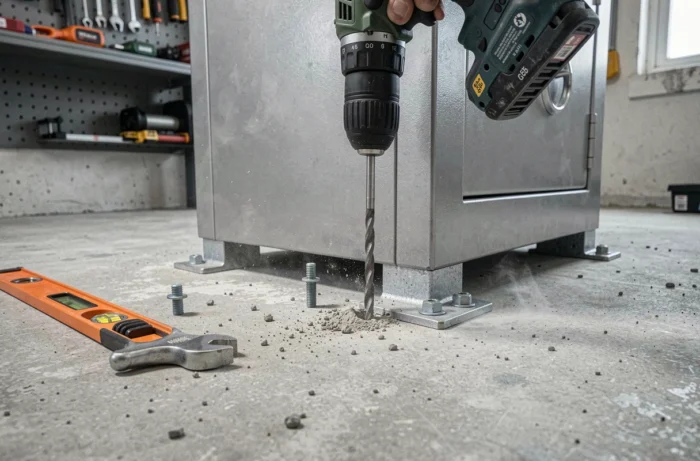
This is the most accessible solution for an individual equipped with a hammer drill. The safe is drilled with fixation holes at the bottom of the box. One drills the slab, inserts anchor bolts or threaded rods sealed with resin, and then tightens. The safe becomes integral with the slab, which forces a thief to break the concrete to extract it.
Sealing in a load-bearing wall
The safe embedded in a load-bearing wall made of concrete blocks or concrete offers superior discretion, but the installation is heavier. One must cut a niche that exceeds the dimensions of the safe by at least ten centimeters on each side, then seal with mortar. This operation requires checking the thickness of the wall (sufficiently wide to accommodate the depth of the safe plus the sealing margin) and the possible presence of reinforcements.
In-ground installation (safe buried in the slab)
The safe is embedded in the ground, flush or slightly below the finished level, and then covered with a cap or a coating. The resistance to pulling out is maximum since the safe is embedded in concrete on several sides. In return, this installation requires pouring or re-pouring part of the slab, which limits it to new constructions or heavy renovations.
- Accessible concrete floor and hammer drill available: anchoring to the floor with anchor bolts offers the best security/difficulty ratio for a skilled DIYer.
- Thick load-bearing wall in concrete blocks or concrete: wall sealing is suitable if discretion is a priority and if the wall allows cutting without affecting a structural element.
- New construction or renovation with slab replacement: the buried safe offers the highest level of protection but requires the intervention of a mason.
Detection of hidden networks and preparation for drilling
Drilling a slab or load-bearing wall without prior verification exposes one to real risk. Water pipes, electrical conduits, or gas lines may cross the chosen fixation area.
A multifunctional material detector (detecting ferrous metals, copper, and live current) allows for spotting these networks before the first drill hit. This check takes a few minutes and prevents a water leak or a short circuit in the slab.
Once the area is validated, drilling generates a significant amount of concrete dust. This dust, if left in the hole, prevents the sealing resin from adhering properly to the walls. Each hole must be vacuumed and brushed with a brush before injecting resin. Without this cleaning, the anchoring strength significantly decreases.
After tightening the fixings, a curing time of 48 to 72 hours is recommended before loading the safe. This delay allows the chemical resin to reach its nominal strength. Loading the safe immediately risks stressing the anchors before complete polymerization.
Home insurance and proof of proper fixation
A safe placed on the floor without fixation, even weighing several dozen kilos, is not always considered “sealed” by the insurer. The distinction between “placed” and “fixed” has direct consequences on compensation in the event of theft.
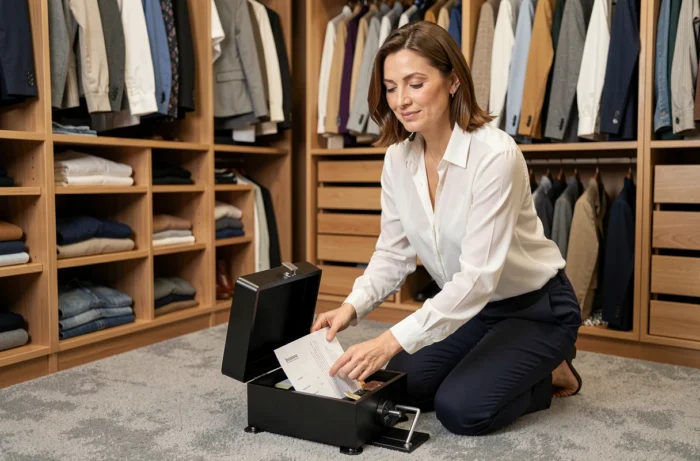
Several insurers require keeping the purchase invoice of the safe, the manufacturer’s assembly instructions, and, in some cases, a certificate of compliance with the applicable European standard. Without these documents, the claim may be reclassified and compensation reduced or denied.
- Keep the invoice mentioning the model, security class, and the fixation method recommended by the manufacturer.
- Retain the installation instructions with the specifications of the anchors or resin used.
- Photograph the completed fixation (holes, bolts, tightening) before closing the safe and replacing any floor covering.
- Check with the insurer the maximum amount covered based on the type of safe and its fixation method.
The choice between floor fixation, wall sealing, or buried installation is not solely about mechanical resistance. The type of available flooring, the ability to intervene oneself on reinforced concrete, and the documentary requirements of the insurer weigh equally in the decision. A well-executed anchoring on a solid slab, with properly polymerized resin and retained documents, protects the stored goods as much as the safe itself.