
The Bosch CSB 500 RE is one of those entry-level corded drills that have been on the market for years, both new and used. With a 500 W motor and a very accessible price point, it targets common household tasks: drilling in wood, thin metal, and, with the hammer function, light masonry materials.
The model shares its technical base with the PSB 500 RE, whose Bosch manual dates back to 2012, which says a lot about the age of its design.
Chuck of the Bosch CSB 500 RE: the documented weak point
Before discussing power or versatility, one element deserves to be mentioned right away because it frequently appears in user feedback: the chuck. According to available reviews, particularly those compiled on Russian-speaking evaluation platforms for the PSB 500 RE (same technical base), the chuck is deemed unreliable over time.
The criticisms focus on play that appears after a few months of regular use and on a deterioration in the grip of the bits. For an occasional DIYer who drills a few holes per quarter, the problem may remain invisible. For more sustained use, replacing the chuck becomes a point to anticipate.
It is possible to discover the Bosch CSB 500 RE drill in detail to check the exact specifications of the chuck and its compatibility with standard replacement chucks.
This defect is not a dealbreaker in itself, but it conditions the type of work for which the machine remains relevant. On a renovation site with daily drilling into concrete blocks, it is not the right tool. For mounting shelves or assembling furniture, the question does not really arise.
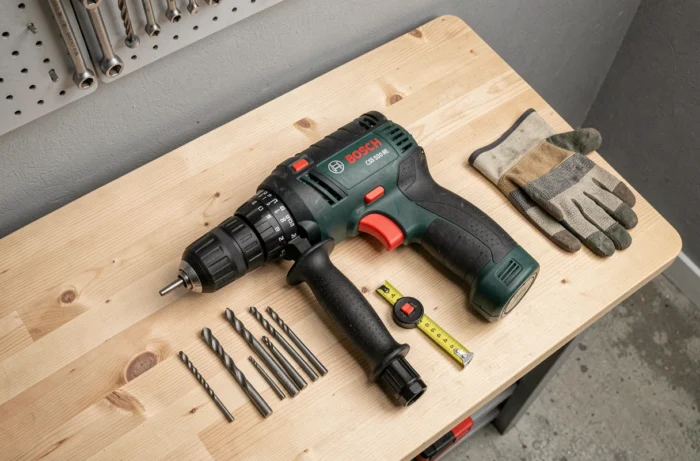
500 W power in corded hammer mode: what it really allows
A 500 W motor places the CSB 500 RE at the lower end of the spectrum for corded hammer drills. Mid-range professional models feature significantly more powerful motors and can drill larger diameters in concrete.
With 500 W, the CSB 500 RE can drill into hollow brick and soft concrete blocks without major difficulty. However, on reinforced concrete or dense materials, progress becomes laborious and the bit heats up quickly. The cam-driven percussion (mechanical), common in this price range, generates less impact force than a pneumatic system.
Work suited to this power
- Drilling in soft and hard wood with standard bits, without forcing the feed
- Drilling in thin metal (sheet metal, aluminum profiles) at reduced speed with lubrication
- Wall fixings in brick, plaster, and hollow concrete blocks with percussion activated
- Light screwing and unscrewing, although the lack of a fine electronic speed control limits precision on small screws
The limit is clearly beyond 10 mm in hard masonry. Beyond that, either a more powerful model is needed, or a dedicated hammer drill. Field feedback varies on this point: some users report successful drilling in solid concrete, while others describe a tool that struggles and overheats quickly.
Bosch CSB 500 RE: an old model still relevant in the used market
The technical document from Bosch referenced for the PSB 500 RE dates back to 2012. More than a decade later, the CSB 500 RE mainly circulates in the used market. Listings on platforms like Leboncoin or resale groups confirm this trend.
This positioning in the secondary market is not a coincidence. The model was not designed to compete with current corded drills, which incorporate finer electronic speed controls, better quality keyless chucks, and sometimes anti-vibration systems. The CSB 500 RE belongs to a generation where mechanical simplicity prevailed.
Buying new or used: criteria to check
In the used market, the price drops to a very low level, making it an acceptable emergency tool. Before buying, three points deserve inspection:
- The condition of the chuck: check for play by tightening a bit and trying to move it laterally
- The operation of the hammer selector: it should engage and disengage without force
- The condition of the power cord and trigger: a damaged cord or a sticking trigger indicates intensive use
When buying new, the question arises differently. Newer models offer more features for a comparable budget. The Bosch UniversalImpact or the GSB 13 RE, for example, offer better-sized motors and more robust chucks.

Ergonomics and handling of the Bosch 500 RE drill
Users who appreciate the CSB 500 RE almost systematically mention its compactness and light weight. The plastic casing, while not offering the durability of a metal housing, helps keep the weight down. For work at height or in tight spaces, this factor matters.
The main handle features a rubberized coating that improves grip. The auxiliary handle, screwed onto the neck of the chuck, is easily repositioned. These elements remain basic but functional for a drill in this category.
The vibration level is not specified by Bosch for this model with the same precision as in professional ranges. During prolonged drilling sessions in masonry, fatigue sets in faster than with a model equipped with a dedicated anti-vibration system.
The Bosch CSB 500 RE fulfills its role as a supplementary drill for home DIY. Its chuck remains the weak link to watch, and its power limits it to soft to moderately hard materials. For a few euros in the used market, it can be a handy tool. For a new purchase intended to last, current alternatives in the Bosch range offer a better quality-longevity ratio.