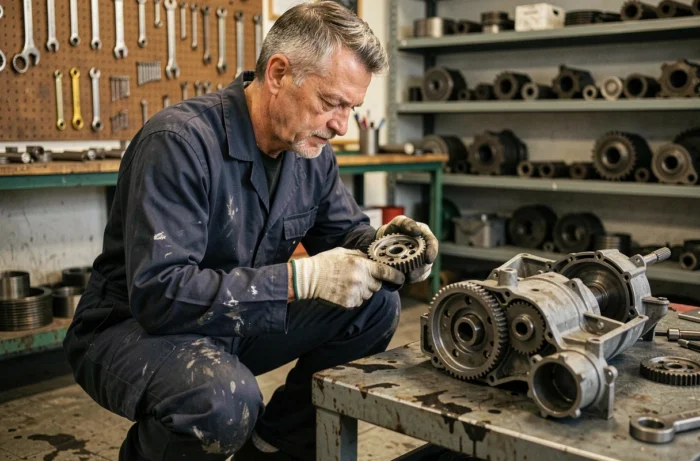
A dog-clutch gearbox is a mechanical transmission in which gears are engaged by directly interlocking teeth (the dog clutches) between two rotating components, without the synchronizer rings found in a conventional manual gearbox. This design eliminates the need to synchronize rotational speeds before shifting, reducing shift times and mechanical losses.
How a dog clutch works: direct engagement without synchronization
In a synchronized gearbox, friction cones equalize the speeds of the input and output shafts before the gear engages. This takes a few tenths of a second and absorbs some of the transmitted energy.
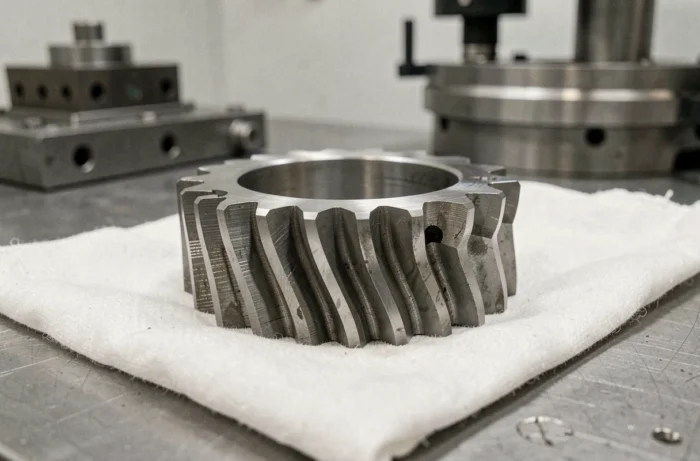
A dog clutch bypasses this step. Two toothed sleeves, each fixed to a shaft, mechanically interlock. Engagement is almost instantaneous, but the speed difference between the two shafts must be small or zero when the gear is selected.
In motorsport (Formula 1, rallying), the driver briefly lifts off the throttle, or the electronics adjust engine speed to allow engagement. In recent hybrid transmissions, an electric motor synchronizes the shafts before the shift, making the operation seamless for the driver. To better understand the advantages of a dog-clutch gearbox in this context, it helps to keep its fundamental mechanical simplicity in mind: fewer friction components mean fewer losses.
Efficiency and compactness of dog-clutch gearboxes compared with other transmissions
The main advantage of a dog-clutch transmission is its very high mechanical efficiency at each gear mesh. Renault claims 98.5% efficiency per gear mesh for the multimode gearbox in its E-Tech range. This figure is explained by the absence of parasitic friction: no synchronizer rings and no hydraulic torque converter.
Its compactness follows the same logic. Fewer internal components mean a smaller casing and lower weight than an equivalent manual gearbox or, even more so, a conventional automatic gearbox with planetary gearsets.
What efficiency means in practice
In a hybrid vehicle, every percentage point of efficiency gained in the transmission translates into slightly greater electric range and lower fuel consumption. The combustion engine runs for less time to deliver the same amount of energy to the wheels.
A dog-clutch gearbox transmits almost all the torque without dissipating heat, unlike a torque converter, which heats the oil to absorb differences in rotational speed. This explains why motorsport adopted the principle decades ago, long before it returned to production vehicles.
Renault E-Tech hybrid transmission: the electronically controlled dog clutch
Renault reintroduced the dog-clutch gearbox in its production models with the full hybrid E-Tech range, equipping vehicles such as the Rafale, Austral, Espace and Symbioz. This architecture combines a multimode dog-clutch gearbox, without a conventional clutch, with two electric motors and a combustion engine.
One of the electric motors acts as a synchronizer, adjusting the shaft’s rotational speed so the dog clutches engage at the right moment. The control unit continuously manages torque distribution between the three power sources and the different gears.
No mechanical reverse gear
On some E-Tech versions, reverse is provided solely by an electric motor. The gearbox has no reverse gear. This design choice further reduces the transmission’s weight and shows how hybridization is changing the traditional functions of a gearbox.
This close integration of mechanical and electronic systems sets the modern dog-clutch gearbox apart from its purely mechanical predecessor. The physical principle remains the same, but gear changes are managed entirely by the onboard software.
Everyday limitations and drawbacks of a dog-clutch gearbox
The direct interlocking of the teeth produces a characteristic noise during gear changes, sometimes noticeable in the cabin as clunks or slight jolts. In the first generations of the E-Tech gearbox, some users reported juddering at low speeds or during transitions between electric and combustion-engine modes.
- Software calibration plays a decisive role in driving comfort: the same hardware can deliver very different results depending on the onboard software version
- Some recalls have involved components related to the parking function, a separate issue from any defect in the dog clutches themselves
- Driving feel depends as much on the hybrid control strategy as on the mechanical components, which can make comparisons with a conventional automatic gearbox misleading
A transmission without a clutch is not necessarily imperceptible in everyday use. Comfort depends on the quality of the hybrid strategy programmed into the control unit, and successive software updates have addressed some of the jolts reported in the first model years.
Wear and maintenance
Dog clutches are subjected to significant mechanical stress every time they engage. Tooth wear is more pronounced when speed differences are not properly managed, again highlighting the importance of reliable electronic control. Maintenance focuses on the gearbox oil and control-unit updates, both of which are included in the manufacturer’s maintenance schedules.
A dog-clutch gearbox remains a precise engineering compromise: greater efficiency and remarkable compactness, but a reliance on software calibration that determines driving comfort. In recent hybrid vehicles, calibration quality has improved with successive updates, and the next generation of E-Tech powertrains confirms that Renault is continuing to refine this architecture rather than abandon it.