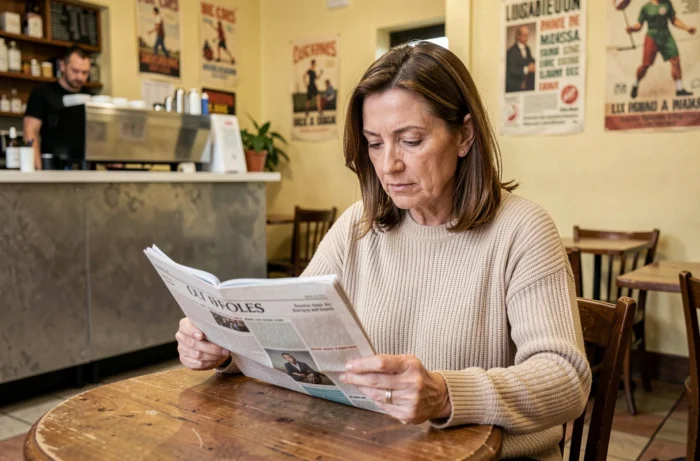
Local news refers to information produced at the municipal, departmental or regional level, covering topics that directly affect residents’ daily lives: urban planning, local incidents, cultural events, municipal decisions and regional sports. Keeping up with this news means combining several types of sources, since no single outlet covers every level of a region.
Online regional press and location-based alerts
Regional daily newspapers remain the backbone of local news in France. Publications such as Le Progrès, covering the Rhône and Loire departments, and regional editions of France 3 (Auvergne-Rhône-Alpes, Grenoble, Saint-Etienne) publish a steady stream of articles on local incidents, politics, demonstrations and economic life.
These newsrooms generally offer digital editions organized by department. Le Progrès, for example, distinguishes between Ain Est, Loire Nord, Sud Lyonnais and Villefranche. This structure lets readers filter content so they only receive news relevant to a specific local area.
Most of these outlets offer notifications based on geographic area. By enabling alerts in the app or on the website, a reader in Lyon will receive news about the metropolitan area first, while a resident of Savoie can go straight to stories from their department. This geolocation is the first step toward avoiding information overload from an overly broad national news feed.
Beyond traditional newspapers, some platforms aggregate news at the hyperlocal level. Sites such as actu.fr organize their content by region (Brittany, Normandy, Pays de la Loire) and let readers follow the latest news from 100 Pour 100 Annonces alongside major regional publications, with coverage sometimes extending down to the municipal level.
Municipal channels and local monitoring tools
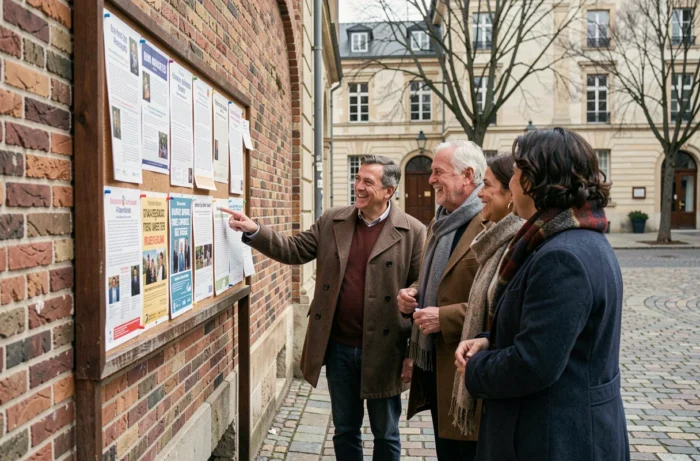
Regional newspapers rarely cover very local decisions, such as roadworks on a particular street, changes to waste collection centre opening hours or a weather alert for a specific neighbourhood. At this level, digital municipal channels fill the gap.
Apps such as PanneauPocket allow municipalities to publish announcements and alerts directly for residents. Several towns, from Bransles (Seine-et-Marne) to Monterfil (Ille-et-Vilaine) and Hundling (Moselle), use the service to share practical information that local newspapers do not always cover.
What these municipal tools cover
- Safety alerts and traffic restrictions related to roadworks or local events, often shared faster than in the press
- Community group announcements, market dates and exceptional closures of municipal public services
- Information about natural and technological risks in the area, sometimes drawing on public data such as the Géorisques API listed on data.gouv.fr
The main advantage of these channels is their immediacy and municipal-level detail. A printed municipal bulletin arrives once a month. A PanneauPocket notification arrives in real time.
Distinguishing reliable local news from promotional content
Using multiple local news sources brings a rarely mentioned risk: confusing journalism with institutional or commercial communications. An article in a regional newspaper goes through an editorial team. A post on a town hall website or a municipal social media account is public communication, governed by a different editorial framework.
This distinction becomes particularly important during election periods. A guide published by ELMARQ notes that electronic messages are subject to restrictions on election campaigning. Regulation (EU) 2024/900 also sets out transparency and targeting rules for political advertising, applicable since October 2025. In practice, locally sponsored content on social media during a campaign may be subject to transparency requirements that readers might not immediately notice.
Three ways to verify local news
- Identify the source: a newsroom (Le Progrès, France 3 régions, actu.fr) is accountable for its editorial content, unlike a municipal Facebook page or an association’s account
- Cross-check with a second local outlet before sharing a local incident or a claim involving figures, since factual errors are more common in non-journalistic publications
- Check the publication date, especially for articles that resurface in search results months later, often around a similar event

Organizing your local news monitoring without information overload
Following regional newspapers, municipal apps and aggregation platforms at the same time can quickly generate more information than you can take in. The key is to choose two or three complementary sources rather than ten that repeat the same stories.
For example, a reader in the Rhône could combine the Lyon-Villeurbanne edition of Le Progrès for departmental coverage, PanneauPocket for alerts from their municipality, and the regional section of an aggregator such as actu.fr for a broader view of life in Auvergne-Rhône-Alpes. A resident of Isère might instead follow ICI Isère (France Bleu/France 3) for news from Grenoble and the department, supplemented by a municipal channel.
Most of these sources offer newsletters tailored to specific areas, often daily or weekly. Subscribing to a targeted local newsletter provides a structured summary without having to visit each site individually. It is the most effective format for readers who want to keep up with news from their local community without spending more than a few minutes a day on it.
The right sources also depend on the type of information you are looking for. Regional newspapers’ local editions provide better coverage of festivals, leisure activities and cultural events. Practical alerts and administrative decisions are shared more quickly through municipal channels. No single tool can replace this combination, but three well-chosen sources are enough to cover the essentials of an area.