A garden that provides a true sense of well-being does not rely on an accumulation of plants or decorations. It depends on a few structural choices made from the outset, which give the place a coherence that is visible at first glance. Creating a harmonious garden at home requires less resources than one might think, but more observation.
The soil and light dictate the garden, not the other way around
Before choosing any plants, observe your land for several days. Identify the shaded areas in the morning and those that receive full sun in the afternoon. This natural mapping conditions everything else.
Clay soil retains water and is suitable for hydrangeas or irises. Sandy soil, which drains better, is more welcoming to lavender or rosemary. Matching plants to the soil avoids half of the failures.
You may have noticed that some gardens seem to grow effortlessly? This is often because the plants correspond to the climate and nature of the land. A Mediterranean garden planted in Normandy will require constant maintenance and yield disappointing results. Conversely, local plants will settle in quickly and gain volume each year.
Resources like L’Esprit Jardin provide ideas for plantings suited to each situation, helping to lay the groundwork for a realistic project.
Plant palette and colors: limit to compose better
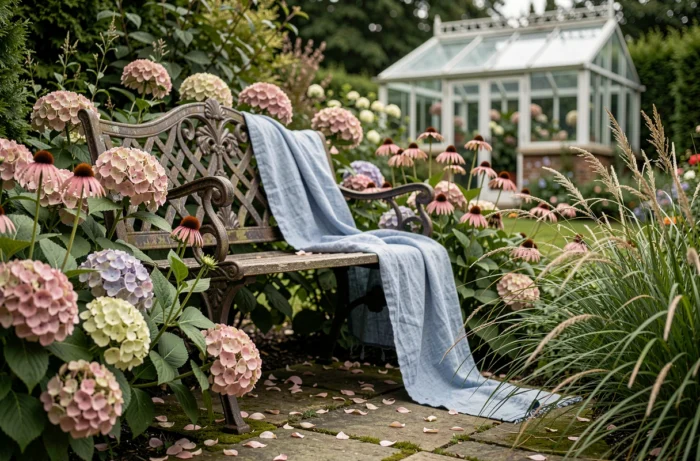
The most common trap is wanting to mix too many varieties. A bed of twelve different species, each with its own color, creates a messy effect. Three to four shades are enough to create a harmonious garden.
Take the reasoning in reverse. First choose a dominant color (green is already a color), then an accent shade (white, blue, pale pink) and possibly a bright touch to punctuate a corner or a pot. This principle works for a small balcony as well as for a large plot.
Play with foliage rather than flowers
Flowers last only a few weeks. Foliage persists for several months, sometimes all year round. Focusing on contrasts in leaf textures (broad leaves of hostas, fine grasses, silver foliage of sage) provides a stable and structured result.
Ornamental grasses, for example, bring movement when the wind blows. They remain decorative even in winter, once dry. This type of plant requires very little water and almost no maintenance once established.
Garden structure: create distinct spaces without partitioning
A harmonious garden tells a story. The eye should be able to rest, move forward, and discover another angle. This does not require a large space.
Define two or three zones with different functions: a dining area near the house, a wilder planting space at the back, a path connecting the two. Even on a plot of just a few dozen square meters, this logic works.
- A low hedge or a row of grasses visually separates the areas without blocking light.
- A path of stepping stones or gravel guides circulation and creates rhythm on the ground.
- A tree or a shrub slightly taller than the rest attracts the eye and serves as a focal point, what landscapers call a “vertical accent.”
- A bench, a pot, or a fountain marks a pause and gives a reason to stop.
The choice of materials is as important as that of plants. Wood and natural stone age better than plastic or raw concrete. They blend into the vegetation over the seasons.

Gardening for well-being: what research confirms
The idea that gardening is beneficial is not just intuition. A meta-analysis published in 2026 in BMC Public Health, covering 23 studies and over 4,500 participants, shows that therapeutic gardening programs improve symptoms of depression and anxiety in adults with chronic illnesses. The effect on mental health is described as moderate but robust.
In contrast, the measured physical benefits (muscle strength, blood pressure) remain low and not significant in this same analysis. Gardening affects morale more than the body, which deserves to be stated clearly.
Urban greenery and collective health
Thinking of your garden as an extension of the local green framework adds an extra dimension to the project. Planting a fruit tree or leaving a corner of wildflowers, contributes to the biodiversity of the neighborhood, not just beautifying your plot.
Minimal maintenance of a flourishing garden: good reflexes
A garden that requires hours each week eventually becomes a chore. The goal is to design a space that thrives well with minimal interventions.
- Mulching the beds with wood chips or fallen leaves reduces watering and limits weeds.
- Grouping plants with similar water needs simplifies watering management.
- Pruning just once a year (late winter for most shrubs) is enough to maintain a clean shape without stressing the plants.
A well-designed garden from the start requires less and less work over the years. The plants thicken, cover the ground, and regulate themselves. This design principle, sometimes called a “low-maintenance garden,” relies on choosing perennials suited to the local climate and on thick mulching.
The best season to start such a project remains autumn: the soil is still warm, the rains return, and the plants planted during this period develop their roots before spring. A garden installed in October often has several months’ advantage over one planted in March.