
A volume of 4m3 corresponds to a loading space of about 2.10 m long, 1.60 m wide, and 1.35 m high. This van format is aimed at small moves, studio transfers, or occasional furniture relocations. Understanding the physical limits of this space allows you to anticipate what can actually fit in the truck, and especially what cannot.
Interior height of a 4m3 van: the constraint that no one measures
Most content on the subject lists furniture and boxes without addressing the most structural constraint: the usable height of the van, limited to about 1.35 m. This data radically changes the way to load.
A standard refrigerator measures between 1.50 m and 1.80 m high. A two-door wardrobe often exceeds 1.80 m. None of these pieces of furniture can stand upright in a 4m3 van. They must be laid down, which consumes the entire usable length of the floor (about 2.10 m), or they must be disassembled beforehand.
Laying a refrigerator down poses an additional technical problem: the compressor and the refrigerant circuit do not handle prolonged tilting well. Manufacturers generally recommend letting the appliance rest upright for several hours before plugging it back in after being transported on its side. To explore in detail what can fit in 4m3 of moving, this height constraint should be the first criterion for selecting the furniture to be loaded.
Payload of the 4m3 truck: weight matters as much as volume
Filling 4m3 with boxes of books is technically possible in volume. In weight, it’s another matter. Each van has a maximum payload, determined by the difference between the GVW (gross vehicle weight) and the empty weight of the vehicle.
For a recent 4m3 van of the small utility type, this payload is around 1,200 kg depending on the models. This figure seems comfortable, but it quickly diminishes with dense furniture.
- A standard box filled with books or dishes weighs between 15 and 25 kg. Twenty boxes of this type already represent 300 to 500 kg.
- A washing machine weighs on average 60 to 80 kg. A small refrigerator, 30 to 50 kg.
- A two-seater convertible sofa can reach 50 to 70 kg depending on the structure and mechanism.
Exceeding the payload is an offense punishable by a fine, and it also poses a risk for braking and road handling. Before loading, mentally weighing each category of items avoids unpleasant surprises at tolls or during a check.
Realistic content of a move in 4m3: studio and small spaces
The volume of 4m3 is suitable for a studio-type accommodation or a furnished room. Not a fully equipped T2. Here’s what can actually fit in this space, taking height and weight into account.
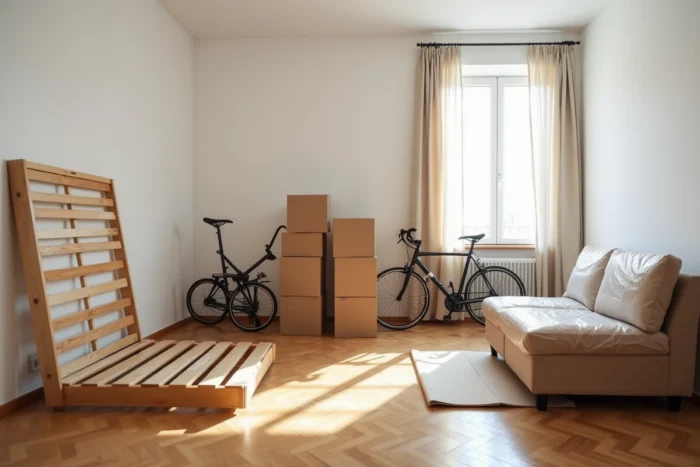
A single mattress, folded or rolled if it’s foam, takes up relatively little floor space. A removable slatted bed base slides along a wall. A folding table, two chairs, a small desk, and a few disassembled shelves complete the rigid furniture.
Regarding boxes, about twenty standard boxes fit in the remaining volume, provided they are stacked methodically. The heaviest boxes (books, dishes) go on the bottom, the lighter ones (linen, clothes) on top.
What generally does not fit: a three-seater sofa, a washing machine AND a refrigerator at the same time, a non-dismantled bookshelf, a corner desk. The 4m3 imposes trade-offs. Two trips with a 4m3 van can sometimes be cheaper than a single trip in a 10m3, depending on the distance.
Estimating moving volume: room-by-room method
Estimating your volume before booking a van avoids the too-small truck (stress, second trip) or too-large truck (unnecessary extra cost). The most reliable method is to calculate the volume room by room rather than guessing a total.
For each room, list the furniture with their approximate dimensions (length, width, height) and then multiply these three values to obtain the unit volume in cubic meters. Adding the results gives the gross volume.
Then apply a packing coefficient of about 10 to 20%: furniture is not perfect cubes, and the air between objects inflates the actual volume. A studio whose furniture occupies 3.2 m3 in gross volume will practically require a loading space of 3.5 to 3.8 m3, which remains compatible with a 4m3 van.

Common estimation errors
Forgetting items outside of furniture is the most common mistake. Vacuum cleaner, drying rack, ironing board, shoe boxes, sports bags: these items seem negligible individually, but easily take up half a cubic meter once grouped together.
Another trap: overestimating the capacity of boxes. A standard box does not hold everything you would like to put in it. Fragile items require bubble wrap or newspaper that reduces the usable volume of each box by a good third.
Optimizing the loading of a 4m3 van: order and method
Loading a 4m3 van is not improvised. The loading sequence determines both the stability of the journey and the actual amount of items transported.
First, place the heaviest and bulkiest items at the back of the van, against the partition with the cabin. The mattress, laid flat or against a side wall, then serves as protection for fragile furniture.
- Dismantled furniture (shelves, slatted bed base, table legs) slide along the walls to utilize dead spaces.
- Heavy boxes form a stable base in the center. Lighter boxes and bags fill the gaps above.
- Fragile items (screens, mirrors, lamps) are secured last, accessible as soon as the doors are opened.
Straps and protective blankets are not optional. A piece of furniture that slides during braking can damage the rest of the load and destabilize the vehicle.
The 4m3 format remains the right choice for a studio or as an addition to a move. Its main limit is neither the volume nor the weight taken in isolation, but the combination of both with an interior height that forces a rethink of how each item fits into the van.