
Behind every DIY home project, even modest ones, lie questions of preparation, safety, and material choices that inspiration guides rarely address. Understanding these issues before driving the first screw changes the very nature of the outcome.
Identifying networks and electrical safety before work
Drilling a wall to fix a shelf or run a conduit may seem trivial. Field reports show that it is precisely during these simple actions that incidents occur.
Enedis explicitly reminds us to locate cable pathways before drilling and to use an appropriate cable detector. In case of doubt about the nature of an embedded network, the recommendation is to contact an electrician before intervening. This precaution is crucial for the actual feasibility of any interior renovation project.
Beyond electricity, preparing the support is one of the most underestimated steps. Several recent sources emphasize the verification of networks and planning of steps as prerequisites for any domestic project, including small renovations. Allowing for a margin of unexpected events, both in time and budget, prevents abandonment along the way.
To learn more about Mulot Bricole, the site brings together resources covering both tools and project methodology.
Common DIY mistakes: what beginners overlook
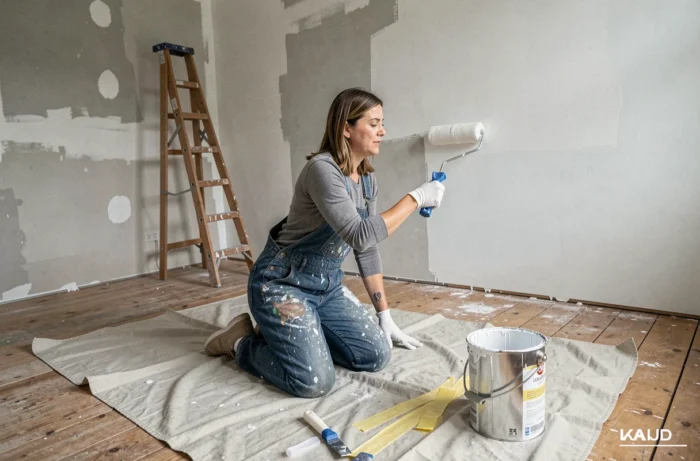
Recent specialized content converges on a finding: the most common mistakes are not technical but organizational. Poor estimation of material quantities, lack of floor protection, tools unsuitable for the support—these issues repeat from one project to another.
Among the recurring pitfalls identified by several specialized blogs:
- Underestimating drying time between two coats of paint or plaster, which compromises adhesion and forces a redo
- Using a drill bit or blade unsuitable for the material (wood, concrete, drywall), which damages the support and prematurely wears out the tool
- Neglecting repeated measurements, while the rule of “measure twice, cut once” remains the most effective advice in carpentry as well as in laying coverings
- Forgetting to cut off the electrical supply or water supply before working on an existing circuit
These mistakes do not stem from a lack of talent. They reflect a methodological flaw that most DIY tips guides bypass in favor of an appealing final result in photos.
Upcycling and circular economy: DIY beyond new
Home-focused DIY increasingly incorporates a circular economy dimension. It is no longer just about creating a piece of furniture or a decorative object, but about giving a second life to existing materials before buying new ones.
Upcycling involves transforming an item destined for disposal into something functional or aesthetic, without going through an industrial recycling process. Pallets turned into bookshelves, jars converted into lamps, scraps of wood assembled into a tabletop—there’s no shortage of concrete projects.
This approach serves a dual purpose. On one hand, it reduces the cost of decoration and renovation projects. On the other, it limits the amount of waste produced. Available data does not allow for precise quantification of the environmental impact on an individual scale, but the editorial trend is clear: the most consulted DIY content now values reuse as much as pure creation.
For a beginner, upcycling offers an additional advantage: reclaimed material costs little or nothing, which reduces the pressure in case of failure. Messing up a cut on a pallet board does not have the same financial impact as on solid oak purchased in a store.
Legal aspects and guarantees: the blind spots of home DIY
One aspect almost absent from inspirational content: the contractual and legal framework surrounding DIY work. When an individual makes modifications to their home, several questions arise.
In co-ownership, certain works require prior authorization from the property manager, even if they concern the interior of the unit. Modifying a load-bearing wall, changing a flooring that may affect sound insulation, or moving a water point are all regulated interventions.
For larger projects partially entrusted to a professional, the questions of quotes, post-work guarantees, and recourse in case of defects should be raised before starting the work. Some specialized sites now address mediation procedures and insurance related to domestic work, an angle that creative idea blogs generally do not cover.
Field reports vary on this point: depending on the nature of the work and the status of the housing (owner, tenant, co-owner), obligations can vary significantly. Checking with the local council or insurance provider before launching a large-scale project remains the most reliable approach.
Choosing DIY projects according to your actual level
The temptation is strong to embark on an ambitious project after watching a few videos. Feedback from beginner DIYers shows that progress comes from calibrated projects, not from the ambition of the final result.
- Beginner level: wall fixings, small repairs (silicone seal, handle replacement), painting a room with surface preparation
- Intermediate level: laying flexible flooring, assembling simple custom furniture, creating wooden shelves with cutting
- Advanced level: insulation work, modifications to electrical or plumbing circuits (in compliance with standards), building complex furniture
Each level teaches transferable skills for the next. Mastery of drilling, screwing, and clean cutting conditions the quality of all subsequent projects, whether they involve decoration, repair, or furniture making.
Home DIY benefits from being approached as a cumulative skill rather than a series of isolated projects. Project preparation, electrical and hydraulic safety, choosing a project suited to one’s level: these are the foundations that determine the quality of the final result.