
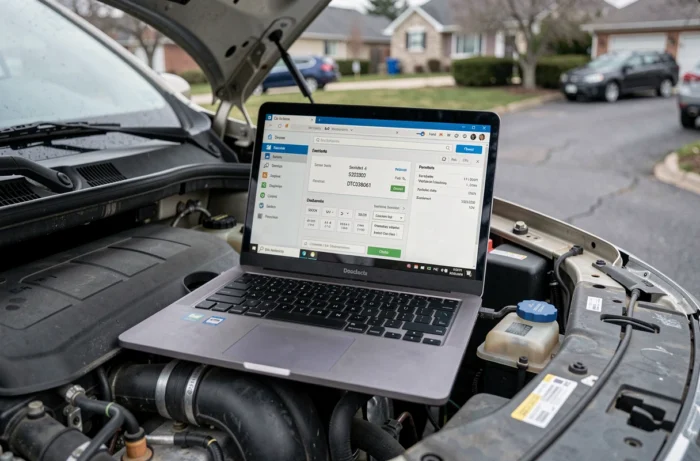
Your diagnostic tool displays a code DTC038061 after a reading on your Renault or Dacia diesel, but no clear label appears on the screen. The glow plug warning light remains on, and cold starting becomes difficult. Unlike the generic code P0380 found everywhere on the web, DTC038061 is a proprietary Renault/Dacia code, linked to a specific ECU. This distinction radically changes the diagnostic approach.
DTC038061 and P0380: why they are not the same codes
Most online tutorials address P0380, a standardized OBD-II code that signals a general anomaly in the glow plug circuit. DTC038061 operates differently. It is an internal code in the Renault/Dacia system, recorded by a specific ECU (injection or glow plug depending on the model).
In practice, your generic diagnostic tool may display this code without any associated description. This is normal. Generic OBD databases do not reference manufacturer codes in the DTC0xxxxx format.
To precisely identify what a dtc038061 issue on Renault and Dacia entails, the best practice is to cross-reference this code with the DF/DTC list specific to your model (Megane 2 1.5 dCi K9K, Logan, Duster, Sandero, for example) and to read the actual values in real-time from the ECU.
Fault status: intermittent or confirmed, two different diagnostics
You may have noticed that a fault code can appear and then disappear without intervention? This is the distinction between a stored fault (intermittent) and a present fault (confirmed). This logic is rarely addressed in guides on P0380, but it is crucial for DTC038061.
Intermittent fault
The ECU detected a one-time anomaly in the glow plug circuit, then the values returned to normal. In this case, an intermittent fault is not treated like a confirmed fault. Before replacing anything, it is necessary to monitor the recurrence of the code over several starting cycles.
A loose connection on a corroded connector, a temporary battery voltage drop, or a micro-fault in grounding is enough to trigger an intermittent DTC038061.
Confirmed fault
The code consistently reappears every time the ignition is turned on, and the symptoms are constant (difficult starting, white smoke, fixed glow plug light). The problem is then active and requires intervention on the circuit.
Causes of DTC038061 beyond glow plugs
Articles on P0380 almost always point to glow plugs or the relay/control unit. For DTC038061, the range of causes is broader because this code can reflect interactions with other vehicle systems.
- Ground or multiplex network fault: a poor ground connection on the engine or a communication issue on the CAN/LIN network can generate this code without any faulty glow plugs. The UCH (Central Body Unit) sometimes comes into play.
- Insufficient battery voltage: a weak battery that drops below the critical threshold during starting causes control anomalies in the glow plugs. The ECU then records a DTC even if the physical circuit is intact.
- Connectors and wiring of the glow plug circuit: oxidation of connectors on the glow plugs or on the control unit remains a common cause, especially on vehicles over ten years old. A simple cleaning may suffice.
- Defective glow plug control unit: on dCi engines equipped with an electronic glow plug management unit (and not just a simple relay), a failure of this module leads to a DTC038061 accompanied by an individual glow plug control fault.
- Glow plugs themselves: one or more broken glow plugs (infinite resistance on the multimeter) remain an obvious classic cause, but not the only one to consider.
Diagnostic method suitable for DTC038061
Rather than a linear step-by-step guide, here is the approach that avoids unnecessarily replacing parts.
Extended parameter reading
With a Renault-compatible tool (DDT4All, PyRen, or a multi-brand tool in manufacturer mode), record the actual values of the glow plug circuit: glow plug voltage measured by the ECU, relay or unit control status, and post-heating duration. This data allows for locating the fault before disassembling anything.
Battery and ground check
Measure the battery voltage when cold, with the engine off, then during starting. If it drops too low during engine cranking, the glow plug circuit receives an incorrect command. Also check the engine-chassis ground straps, which are often corroded on older models.
Testing the glow plugs with a multimeter
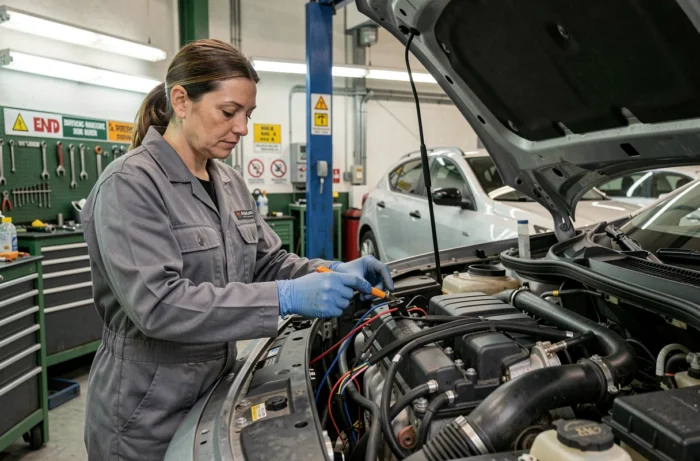
Disconnect each glow plug and measure its resistance. A functional glow plug shows a very low resistance. Infinite resistance indicates a broken glow plug. But be careful: even if all the glow plugs are good, the fault may come from the control unit or upstream wiring.
Inspection of the multiplex network
If no issues are found in the local glow plug circuit, the fault may originate from the CAN network that connects the engine ECU to other modules. A communication fault between the UCH and the injection ECU sometimes causes a DTC038061 unrelated to the glow plugs. This diagnosis requires a tool capable of reading network frames.
Clearing the DTC038061 code: when and how
After each intervention, clear the code via the diagnostic tool, then perform several cold starting cycles. If the code does not return, the problem is resolved.
If DTC038061 was simply stored (intermittent) and you found no physical anomalies, clear the code and monitor for one to two weeks. A code that does not return after clearing often indicated a temporary micro-cut, without lasting severity.
The classic trap with this type of manufacturer code is to replace all four glow plugs outright when the fault comes from a corroded ground or an aging battery. Checking the overall electrical network of the vehicle before touching the glow plug circuit avoids unnecessary expenses and a code that returns after the repair.