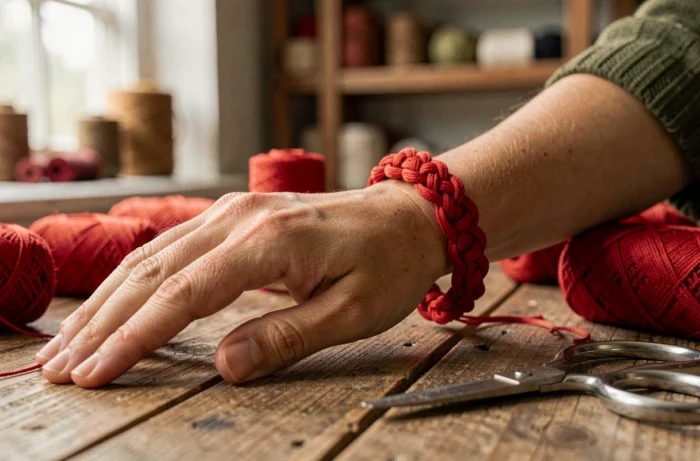
The red 7 knots bracelet is a red thread cord on which seven knots are formed one by one, each knot fixing an intention in the fiber. The most documented tradition links this object to the Kabbalah and the tomb of Rachel, near Bethlehem, where a long red wool thread was wrapped around the monument before being cut into individual segments. The Yiddish term roite bindele (“little red tie”) has referred to this bracelet for several centuries.
Red thread and Kabbalah: what tradition really establishes
The red thread draws its symbolic charge from Rachel, matriarch of the Jewish people, who died in childbirth on the way to Bethlehem. Jewish tradition has made her a protective figure who watches over her children while traveling. The thread wrapped seven times around her tomb, then cut, constitutes the original ritual.
The bracelet is worn on the left wrist, considered in Kabbalah as the receptive side of the body. It must be tied by someone who loves you, and the Ben Porat Yosef prayer accompanies each knot. This ritual framework distinguishes the Kabbalistic red thread from a simple textile accessory.
Anyone wishing to make a red 7 knots bracelet benefits from understanding this origin before moving on to the technical gesture, as the tying only makes sense when connected to a specific intention.
Meaning of the 7 knots: a recent codification, not ancestral
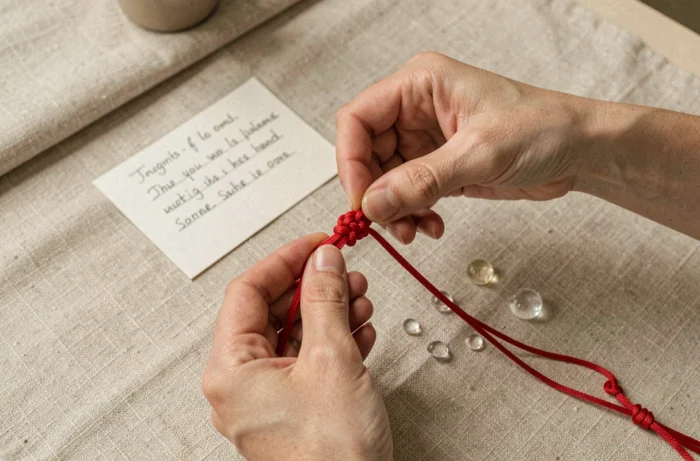
Widely shared lists on social media attribute a specific meaning to each knot: love, money, health, prosperity, success, luck, protection. These correspondences circulate as if they stemmed from a unique and ancient tradition.
An investigation published in 2026 by El Cierre Digital shows that these lists are not based on any universal traditional text. They are recent esoteric and commercial constructions, popularized by online shops and content creators. No classic Kabbalistic work codifies seven distinct meanings knot by knot.
The original Kabbalistic ritual associates each knot with the recitation of a segment of the Ben Porat Yosef prayer, not with a separate theme. The nuance matters: in traditional practice, the seven knots form a protective whole against the evil eye, without thematic segmentation.
This does not disqualify the approach of distinct intentions. Setting a personal intention for each knot remains a symbolically coherent practice, provided one understands that it is a contemporary usage and not a historical prescription.
Material and thread choice for a sturdy bracelet
The thread determines the hold of the knots and the durability of the bracelet. Kabbalistic tradition mentions red wool, but most bracelets sold or made today use waxed cotton, braided nylon, or silk.
- Red wool remains the material most faithful to tradition. However, it absorbs moisture, which weakens the knots over the weeks if the bracelet is never removed.
- Waxed cotton offers a good compromise between flexibility, water resistance, and ease of tying. The waxing prevents the knots from slipping after being tied.
- Braided nylon withstands daily wear better, but its smooth surface makes tightening the knots more delicate: each knot must be pulled firmly to avoid coming undone.
The red color is not decorative. In Kabbalistic symbolism, red is associated with protection and vital energy. Choosing another shade transforms the jewelry into a classic Brazilian bracelet, unrelated to the 7 knots ritual.
Tying the 7 knots: technical gesture and sequence
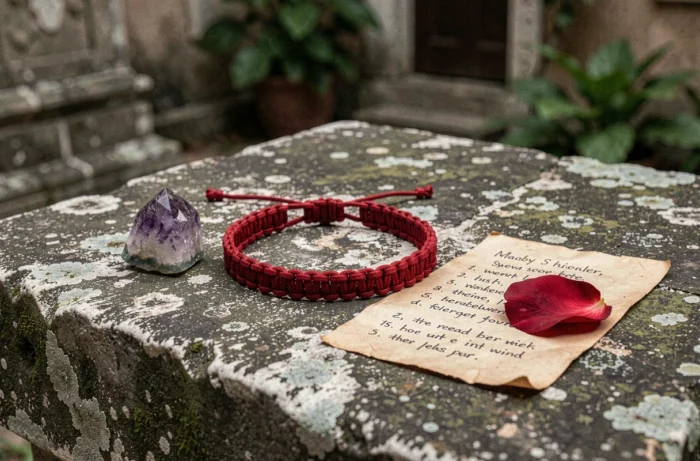
Making it requires a thread about three times the circumference of the wrist. This length provides enough material to form seven simple knots without compressing the wrist.
The bracelet is tied directly on the wrist, not flat on a table. The person tying starts with a first base knot to secure the thread, then continues with six additional knots spaced evenly along the cord. Each knot is a simple knot (overhand knot), tightened gradually, not in one swift motion.
During the tying, each knot is accompanied by an intention formulated mentally or softly spoken. In traditional practice, a segment of the Ben Porat Yosef prayer is recited over each knot. In contemporary usage, a personal intention replaces the prayer.
- Formulate concrete and distinct intentions: “to be more patient with my loved ones” rather than “happiness”.
- Tighten each knot while slowly exhaling. The breathing gesture anchors attention on the tying.
- Cut the excess thread to one centimeter from the last knot to prevent the bracelet from fraying.
Purification and activation of the red bracelet at home
Before being worn, the bracelet can be purified to neutralize residual energies from the material. There are two main methods, but not all are suitable for textiles.
Fumigation with white sage or palo santo remains the technique best suited for a red thread. The textile absorbs moisture, making immersion in saltwater problematic: salt weakens the fibers, alters the hold of the knots, and can discolor the thread. Saltwater is better suited for stone or metal jewelry.
To activate the bracelet, simply pass the thread through the smoke for a few minutes while holding the intention of purification, then tie the seven knots according to the sequence described above. Activation and tying form a single gesture: the bracelet is activated by the intentions placed in the knots, not by a separate step.
Red 7 knots bracelet and wellness trend among young adults
In recent years, the red thread has seen a resurgence of visibility on social media, worn not only as a talisman against the evil eye but also as a marker of self-care and emotional healing among 18-35 year-olds. This reappropriation blends traditional protection symbol and mental health approach.
The red 7 knots bracelet then functions as a physical reminder of consciously set intentions. The thread on the wrist brings attention back to a personal commitment every time one’s gaze falls upon it. This dimension explains its current success beyond esoteric circles.
The red thread remains a simple object, a cord and seven knots. Its strength lies less in the material than in the precision of the intention accompanying each knot, and in the relationship between the person tying and the one wearing it.