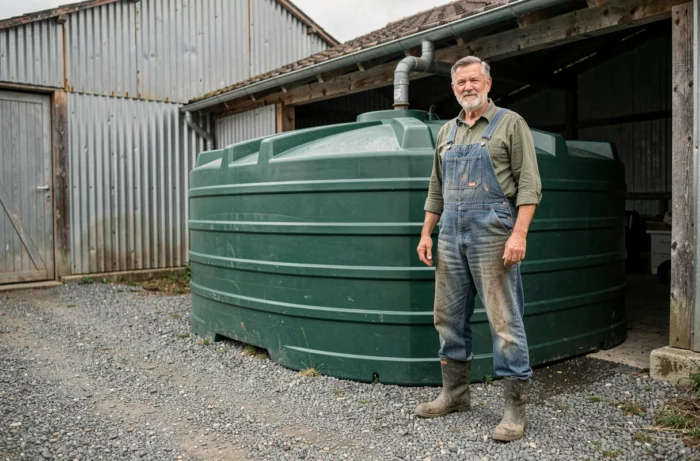
Storing rainwater on a farm reduces dependence on the grid and secures the watering of livestock or irrigation during dry periods. The cost of a rainwater harvesting tank remains a barrier for many farmers, but several schemes allow for significant funding. However, one must know where to look, as the aid does not come from a single source.
Water agencies: the first funder to approach for an agricultural tank
The water agencies are the main lever. Each of the six French agencies has its own programs, with criteria and rates that vary from one basin to another.
The Adour-Garonne Water Agency, for example, explicitly funds the reuse of unconventional water in agriculture. This includes roof rainwater for irrigation or watering. Support can reach up to half of the project’s cost and covers both feasibility studies and the work itself.
A often overlooked point: the scope of aid is not limited to the purchase of the tank. In the Adour-Garonne basin, projects for recovery without a structural storage facility are also eligible. Collecting roof water to directly supply a watering trough, without going through a large reservoir, falls within the scope of the scheme.
You can find information on Finance Factory that summarizes the schemes by basin and by type of project, which avoids having to consult each agency separately.
On the Loire-Brittany side, the agency also offers programs dedicated to agricultural adaptation to climate change, with a specific focus on water resource management. The amounts and conditions change with each multi-year program, hence the importance of checking the current schedule before submitting a file.
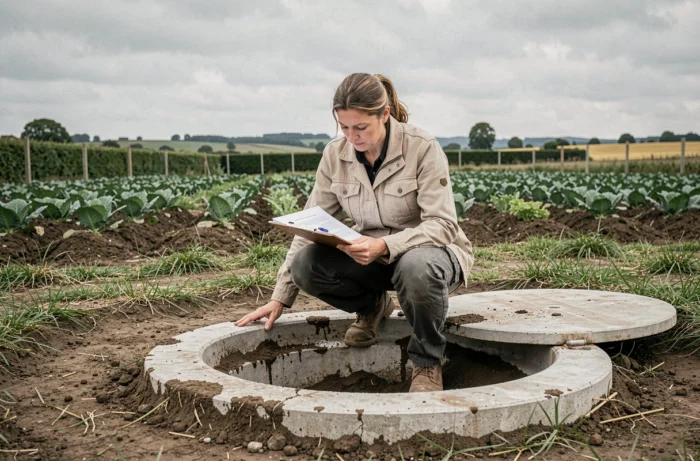
Regional and departmental aid for rainwater recovery in agriculture
Local authorities often supplement the funding from water agencies. These aids are cumulative in most cases, which can significantly reduce the remaining costs.
Regions: programs related to climate adaptation
In Auvergne-Rhône-Alpes, regional aid does not solely target the purchase of a collector. It is part of a broader framework: optimizing water use in livestock farming. A farmer who installs a tank to secure the watering of their herd may be eligible, even if the scheme does not explicitly mention the word “tank”.
The Occitanie Region supports projects for climate change adaptation, some of which concern agricultural water management. Funding is provided through regular calls for projects.
Departments and intercommunalities: targeted support
Some departments offer direct grants. The Rhône department has a “Water Resource for Agricultural Operations” plan that supports investment projects.
- Check the aid from your water agency as a priority, as they often cover the largest part of the funding.
- Consult your regional council’s website to identify calls for projects related to climate adaptation or agricultural water management.
- Contact your departmental agricultural chamber: it lists local schemes and can help you prepare the application.
- Consider cumulative funding: water agency, region, and department can co-finance the same project, within the limits set by each funder.
Preparing a funding application for a rainwater recovery tank: what holds back
Why do some farmers miss out on these funding opportunities? The issue rarely lies in the lack of aid. It relates to how the applications are prepared.
The water agencies clearly distinguish between two categories of projects: structural storage facilities (retention basins, ponds) and lightweight installations (tanks, flexible cisterns, roof recovery systems). A “tank + distribution” project does not follow the same process as a large storage facility. Misclassifying the category can delay the application by several months.
Another common pitfall: starting work before receiving funding approval. Most schemes require that the application be submitted before the work begins. A purchase order signed too early can render the project ineligible.
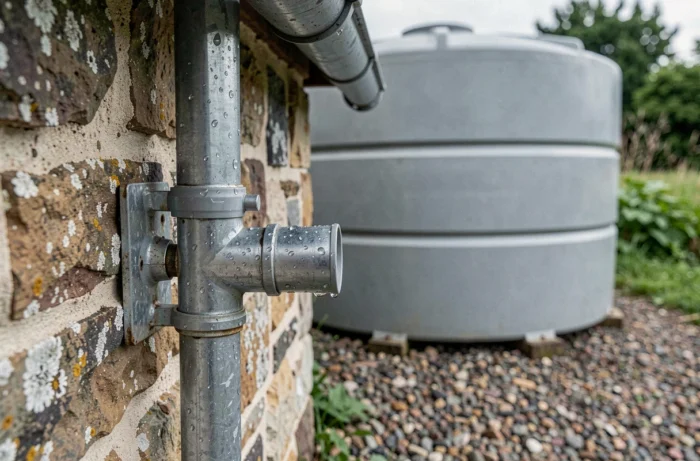
The “studies” aspect also deserves attention. The Adour-Garonne Water Agency funds opportunity and feasibility studies. Having a preliminary study conducted strengthens the application and can sometimes help size the tank to increase the subsidy rate.
Tax credit and reduced VAT: what remains in 2026
The tax credit for the installation of a rainwater collector is no longer available. MaPrimeRénov’ does not cover this type of equipment either.
For homes completed over two years ago, a reduced VAT rate of 10% (instead of 20%) still applies to rainwater supply works. This scheme concerns residential buildings, not strictly agricultural installations. A farmer who equips their house adjacent to the farm can benefit from it, but not for the tank intended for watering the herd.
Agricultural aid is therefore focused on territorial schemes. In the face of increasingly dry summers, the budget allocations dedicated to the climate adaptation of farms are increasing. The concrete outcomes for individual rainwater recovery projects will depend on the distribution between agencies and regions in the coming months.