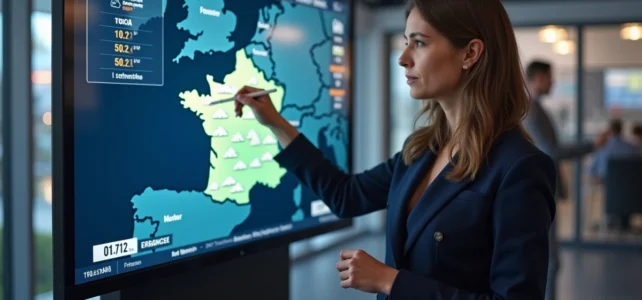
A reliable weather forecast at 24 hours is no longer reliable at five days. This distinction in timing conditions any comparison between Météo-France and La Chaîne Météo. The former is the public operator, mandated by the State to issue official alerts. The latter, published by Météo Consult (a subsidiary of TF1), produces its own forecasting models and relies on a highly editorialized public dissemination.
Comparing their reliability requires understanding what each measures, with what tools, and over what duration.
Meteorological Calculation Models: What Separates the Two Services
Météo-France utilizes the Arpège numerical model, developed in-house, coupled with the fine-mesh Arome model for short-term local forecasts. These models run on the supercomputers of the National Centre for Meteorological Research in Toulouse.
La Chaîne Météo relies on data from Météo Consult, which combines several models, including those from the European Centre for Medium-Range Weather Forecasts (ECMWF) and American sources (GFS). The added value claimed by La Chaîne Météo lies in a statistical post-processing of these models, tailored to French microclimates.
In practice, to evaluate the reliability of Météo France or La Chaîne Météo, the question of the source model matters less than how each service corrects and refines its raw outputs. A poorly calibrated model locally will yield mediocre results, regardless of its prestige.
Forecast Reliability by Deadline: D+1 vs D+7
A forecaster from Météo-France cited by the media Vert indicates that the D+1 forecast is reliable at 90-95%. At four days, this rate drops to around 60-65%. This degradation is not unique to Météo-France: it reflects a physical limit of atmospheric modeling, common to all services.
La Chaîne Météo provides forecasts up to 15 days. Météo-France also offers a 15-day trend, but explicitly presents it as a “trend,” not a forecast. The distinction is significant.
For short-term deadlines (24 to 48 hours), both services offer comparable accuracy for large-scale phenomena (temperatures, general sunshine). The discrepancies widen for localized phenomena: storms, fog, gusts. Météo-France has its own network of ground stations and radars, giving it an advantage in real-time detection.
15-Day Forecasts: A Deceptive Reliability
The Météo Paris website reminds us that announcing a heatwave well in advance remains risky. Forecasts beyond ten days can only provide a thermal trend (warmer or cooler than normal), not a day-by-day scenario. Consulting a D+12 forecast with the same confidence as a D+2 forecast is a common mistake.
Official Weather Alerts: A Regulatory Monopoly of Météo-France
Météo-France holds the legal monopoly on weather alerts in France. Orange and red alerts trigger concrete administrative consequences: activation of emergency plans, closure of establishments, prefectural orders.
Since the update on July 1, 2025, the Labor Code requires the integration of Météo-France’s alert levels into the DUERP (unique document for assessing professional risks). An employer cannot invoke a La Chaîne Météo alert to justify a work stoppage. Only an official orange or red alert, or a prefectural order, is legally acceptable.
La Chaîne Météo publishes its own alert levels, but these have no regulatory value. For professional use (construction, events, agriculture), Météo-France remains the only opposable source.
- Green, yellow, orange, red alerts: official scale issued only by Météo-France, updated at least twice a day.
- La Chaîne Météo alerts: editorial indicators without legal standing, useful for anticipation but insufficient as evidence in case of disputes.
- DUERP and public contracts: only Météo-France’s alert levels are recognized to justify preventive measures or work stoppages.
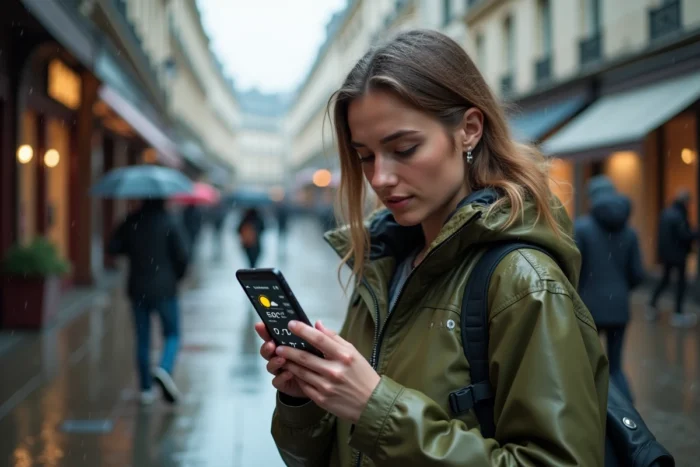
Mobile App and User Experience: Radar, Data, and Privacy
The La Chaîne Météo app has over 100,000 reviews on the App Store with a rating of 4.5/5. It focuses on a polished graphical interface, personalized notifications, and an animated rain radar. The free version includes ads, while a premium version removes ads while adding detailed features.
The Météo-France app has been completely revamped in recent years. It also offers a radar, real-time alert bulletins, and marine or mountain data. The interface remains more understated, sometimes considered less intuitive.
- Rain radar: available on both apps, with comparable resolution in mainland France.
- Hourly forecasts: both services offer them, but La Chaîne Météo provides more detailed information on perceived temperature and UV index.
- Privacy: Météo-France, as a public service, collects less data for advertising purposes. La Chaîne Météo, partly funded by advertising, uses more trackers according to App Store information.
- Specialized features: Météo-France better covers mountain, marine, and aviation needs. La Chaîne Météo stands out in editorial content (videos, weather news articles).
Which Weather Service to Choose Based on Your Use
For professional use related to safety or labor law, Météo-France is the only source with legal value. No private service can substitute for it in the context of a heatwave or storm alert.
For daily use (planning an outing, choosing an outfit), both services are equivalent at 24-48 hours. La Chaîne Météo offers a smoother mobile experience, with a more accessible editorial tone. Météo-France remains more technical, more raw, but also more comprehensive on local phenomena due to its own measurement network.
Beyond five days, neither deserves absolute trust. The physics of the atmosphere imposes increasing uncertainty that neither algorithms nor post-processing can eliminate. Consulting both in parallel, keeping their respective limitations in mind, remains the most reasonable approach.