The daily maintenance of a car is not just a list of mechanical gestures. The context has changed: maintenance costs are rising, drivers are making choices between immediate operations and deferred work, and the choice of service provider (dealership, independent garage, auto center) weighs as heavily as the choice of parts. Maintaining and optimizing your car, in practice, requires understanding where the money goes and what truly protects the vehicle.
Car maintenance and rising costs: what drivers are really prioritizing
The financial burden of a complete annual maintenance has significantly increased in recent years. According to the guide published by Jsemauto in 2026, this expense now represents a significant burden for many households, leading to choices between priority operations and deferred work.
Not all maintenance tasks have the same level of urgency. Postponing a body wash or the replacement of a hubcap poses no risk. However, delaying an engine oil change or a brake fluid check can lead to mechanical failure or compromise safety on the road.
For those who wish to explore autour2moi.fr in detail, the site gathers useful information about the automotive world, from finding service providers to service comparisons.
The logic of prioritization is based on a simple principle: anything related to safety or the engine should never be postponed. The rest can wait a few weeks or months without serious consequences. This hierarchy allows for budget control without exposing the vehicle to rapid degradation.
Independent garage or dealership: where to have your vehicle serviced
Articles on car maintenance generally detail what to do, but rarely where to do it. This choice directly impacts the cost and quality of service. A trend documented by Automobile Magazine shows that the French are gradually abandoning dealerships in favor of independent garages and auto centers for routine maintenance, mainly for price reasons.
Manufacturers have reacted. Several brands now offer extended packages and “bumper-to-bumper” warranties to retain customers within their network. This means that the price displayed at the dealership does not always reflect the actual cost, especially if a package already covers certain operations.
Criteria for choosing the right service provider
- The manufacturer’s warranty still in effect: some clauses require maintenance at an authorized network, or you risk losing coverage. Check the conditions before changing providers.
- The type of intervention: for an oil change, filter replacement, or tire check, an auto center or independent garage is usually sufficient and generally costs less.
- Traceability: regardless of the provider, keep every invoice. An up-to-date maintenance log protects the vehicle’s value as much as a well-done service.
Field feedback varies on perceived quality across networks. An independent garage may be more responsive and cheaper, but the availability of original parts varies. The dealership offers a standardized framework at a higher price.
Fuel consumption: often underestimated optimization levers
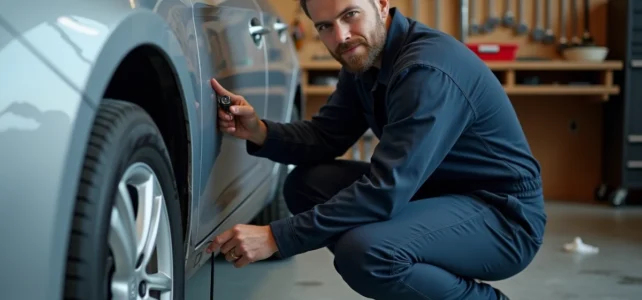
The condition of the tires is the most direct factor affecting fuel consumption, and the easiest to correct. A under-inflated tire increases rolling resistance, forcing the engine to work harder. Checking the pressure once a month, when cold, takes less than five minutes and measurably reduces consumption.
A clogged air filter degrades the air-fuel mixture and increases consumption without the driver immediately noticing. Replacing this filter is one of the inexpensive operations that has a concrete effect on engine efficiency.
Driving habits and consumption
Optimization does not solely rely on mechanics. Driving style plays a significant role. Sudden accelerations and late braking increase consumption much more than aging equipment.
Anticipating braking and maintaining a steady speed on the road are two reflexes that cost nothing and lighten the fuel bill in the long term. On the highway, driving at a slightly reduced speed makes a noticeable difference on a full tank.
Electric vehicles: different maintenance, not nonexistent
With the growing share of electric vehicles in the French automotive fleet, the question of their maintenance arises differently. The absence of engine oil changes or timing belt replacements simplifies the maintenance schedule. This does not mean that maintenance disappears.
Brake fluid, tires, and the battery cooling system remain areas to monitor regularly. Tires on electric cars can wear out faster due to the instant torque of the motor, which requires more frequent condition checks than on a thermal vehicle.
The maintenance network for electric vehicles is still being structured. Not all independent garages have the training or tools to work on high-voltage systems. For operations related to the battery or power electronics, the manufacturer network often remains the only qualified contact.
Monitoring fluid levels: the most cost-effective check
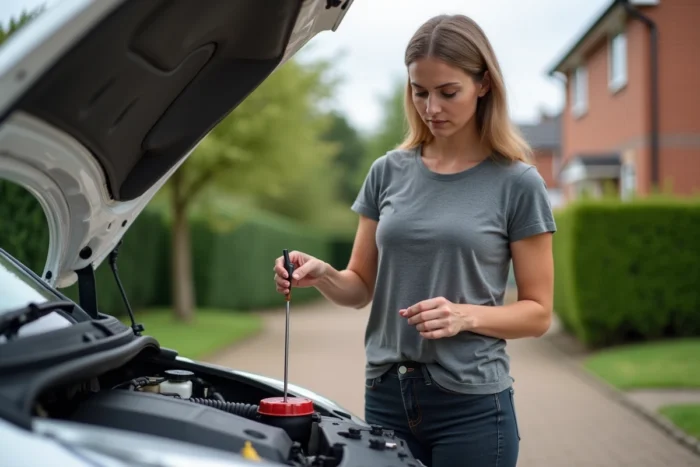
Engine oil, coolant, and brake fluid are three elements whose levels can be checked in a few minutes, with the hood open, without any special tools. An undetected low engine oil level can cause overheating and damage, the cost of which far exceeds that of several oil changes.
- Engine oil: to be checked at least once a month, on flat ground, with the engine off for a few minutes. The dipstick clearly indicates the minimum and maximum levels.
- Coolant: to be visually checked in the expansion tank. A regularly decreasing level may indicate a leak that needs to be addressed quickly.
- Brake fluid: a low level reduces braking efficiency. Replacement is generally done every two years, but regular visual checks remain the first line of defense.
These checks require neither advanced mechanical skills nor specific equipment. They form the foundation of effective car maintenance, the kind that prevents the most costly breakdowns. A vehicle whose levels are monitored every month can accumulate miles without unpleasant surprises, regardless of its age or engine type.