Urban fashion in 2026 is no longer just a list of pieces to wear. The European regulatory framework, changes in silhouettes, and market recompositions are rapidly reshaping this segment. What indicators can measure these changes, and what signals distinguish a fundamental trend from a mere seasonal effect?
Anti-greenwashing directive and urban fashion: what changes concretely in September 2026
Most streetwear trend analyses overlook the regulatory shift that will hit the market as the new school year begins. The European directive Empowering Consumers for the Green Transition (EU 2024/825) comes into effect on September 27, 2026. It prohibits generic environmental claims such as “eco-friendly,” “green,” “sustainable,” or “climate neutral” unless the brand can provide verifiable proof throughout the product’s life cycle.
Self-assigned labels, those small green logos or “eco street” seals without independent certification, also become illegal. Penalties can reach 4% of annual revenue in a member state.
For urban fashion brands that had built their positioning on a vague “urban eco” discourse, the constraint is direct: they will need to rely on data such as Product Environmental Footprint or recognized eco-labels. “Responsible” capsule collections without verifiable traceability will disappear from communications, or expose their creators to lawsuits. You can find all the information on lamodeurbaine.fr regarding the evolution of these practices in the sector.
| Before September 2026 | After September 2026 |
|---|---|
| “Eco-friendly,” “green” claims allowed without proof | Prohibition of unverifiable claims about the life cycle |
| Self-assigned in-house labels tolerated | Independent certification or mandatory public scheme |
| Rare and non-dissuasive penalties | Fines up to 4% of annual revenue |
| “Green Claims” directive project under discussion | Directive withdrawn in June 2025, obligations maintained via EmpCo |
The withdrawal of the “Green Claims” directive project by the European Commission in June 2025 did not lighten the framework. The proof obligations remain fully imposed by the EmpCo directive, which means that streetwear is not exempt from European consumer law.
Oversized silhouettes and quiet luxury streetwear: two opposing lines
Architectural oversized and quiet luxury streetwear coexist in urban wardrobes, but they respond to very different logics. Understanding this gap helps anticipate the pieces that will last beyond a season.
Architectural oversized: volume and construction
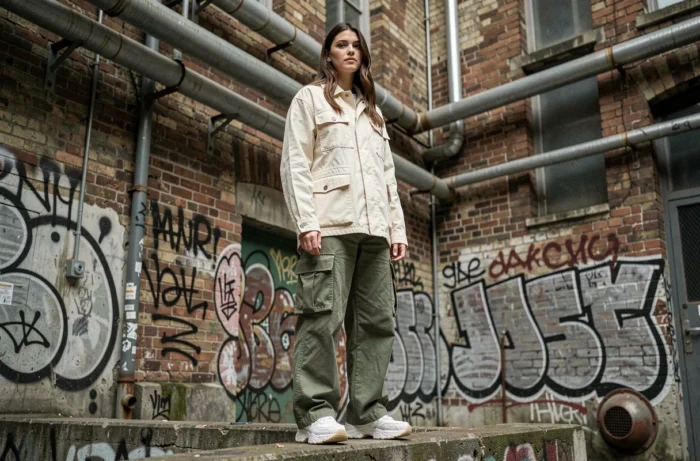
The exaggerated shoulder volume, deconstructed cuts, and asymmetrical proportions characterize this trend. Key pieces include oversized cargo jackets, wide pleated trousers, and structured hoodies. The silhouette moves away from classic sportswear to borrow from technical and utilitarian wardrobes.
Quiet luxury applied to streetwear
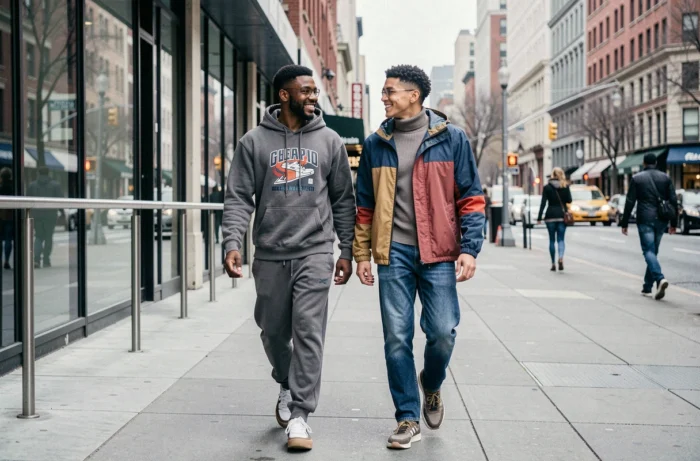
Quiet luxury streetwear eliminates visible logos in favor of refined materials, tailored cuts, and neutral palettes. The hoodie remains, but in heavy fleece, without apparent branding. This line appeals to an audience that wants to maintain street codes without ostentatious markers.
However, these two currents do not share the same relationship to price. The oversized trend plays on accessibility through volume (few cutting constraints), while quiet luxury relies on textile quality, which drives prices up.
Y2K comeback and urban accessories: the pieces that structure 2026 looks
The return of Y2K aesthetics in urban fashion is not limited to low cuts and shiny materials from the 2000s. Several specific elements are redefining outfits this season.
- Trucker caps and flat-brimmed models are back in men’s and women’s urban looks, worn by celebrities in street style photos (Leonardo DiCaprio recently photographed with a signature cap from the 2000s)
- Bold jewelry (thick chains, wide rings) replaces the discreet accessories that dominated previous seasons
- Thick-soled sneakers coexist with slimmer retro models, creating a deliberate contrast in street outfits
Accessories now dictate the identity of a look more than the clothing itself. An outfit made up of urban basics (white t-shirt, cargo pants, sneakers) changes radically depending on whether a Y2K cap or a minimalist grain leather bag is added.
Paris, epicenter of street style: what Fashion Weeks reveal
Paris Fashion Weeks remain the main observation laboratory for urban trends. The looks captured in front of the spring-summer 2027 and autumn-winter 2026-2027 shows show several converging signals.
Bright colors, absent from streetwear wardrobes for several seasons, are reappearing on outerwear: jackets, trench coats, and light jackets. Electric blue and saturated shades dominate, in contrast to the earth tones that marked 2024-2025.
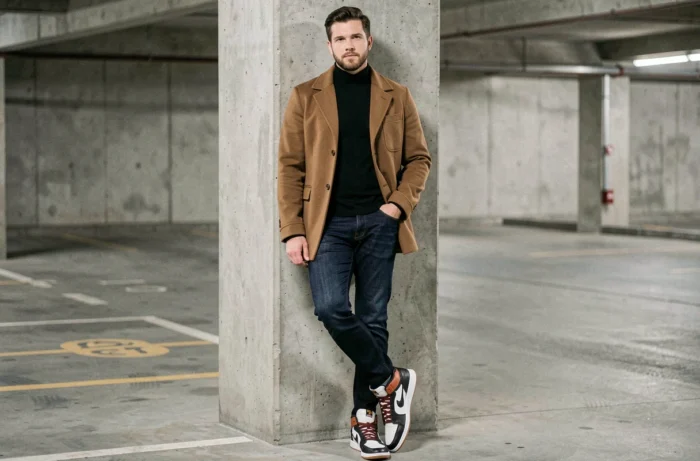
The revisited trench coat establishes itself as a transitional piece between formal wear and street fashion. Worn open over a hoodie or a graphic t-shirt, it illustrates this fusion of styles that characterizes current urban fashion.
The opening of the Footshop store at 63 rue de Rivoli in June 2026 also confirms that Paris attracts new players in the European streetwear market. This Czech brand has chosen one of the busiest commercial axes in the capital for its first French location, a sign that the Parisian streetwear market remains attractive for specialized brands.
Urban fashion in 2026 is viewed through three simultaneous filters: the regulatory constraint that will reshape brand discourses starting in September, the stylistic tensions between volume and minimalism, and the growing role of accessories in constructing a clothing identity. The coming months will reveal whether quiet luxury absorbs streetwear or if the two lines continue to coexist.