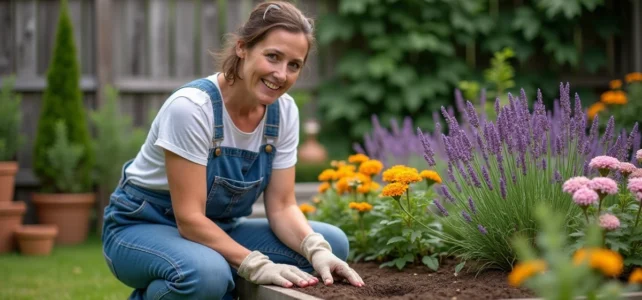
Clay soil that sticks to your boots in March, a flowerbed that turns uniform green by July, rose bushes that languish in the shade of a north wall: we all know at least one of these scenarios. Creating a flowering and productive garden is not just about buying plants at the garden center. The result mainly depends on what you do before and after planting, in the ground.
Preparing the soil without turning it: the foundation of a sustainable flowering garden
Before talking about flowers or varieties, we start with the soil. Many gardeners turn the earth with a spade to its full depth, which destroys the biological life of the top layers. The more effective approach is to loosen without turning, using a broadfork or a digging fork, to decompact without inverting the horizons.
We manually remove the roots of unwanted perennials (bindweed, couch grass) and surface stones. This thorough cleaning prevents the need for constant weeding in the following months. If the soil is compact or poor, we incorporate mature compost on the surface for a few centimeters, without burying it deeply.
For those looking for advice tailored to their type of soil, accessing Conseil au Jardin allows you to refine your choices based on exposure and soil type.
A often overlooked point: rehydrate each pot before planting. Soak the root ball in a bucket of water until no more bubbles appear. A plant put in the ground with a dry root ball struggles to produce new roots, even in moist soil.
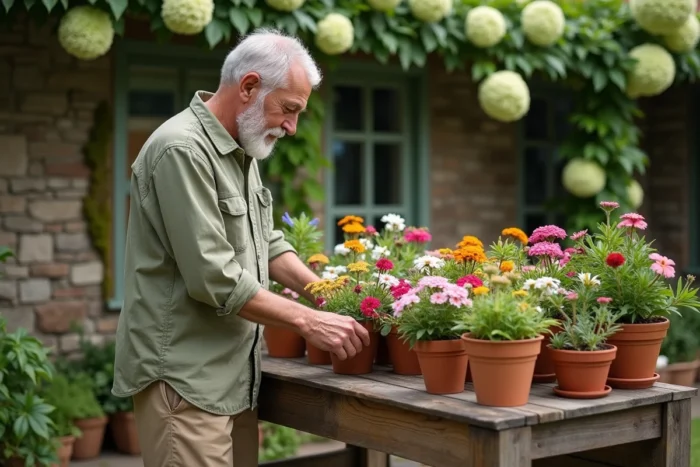
Thick mulching after planting: reduce watering and weeding
Mulching is probably the action that most changes the daily management of a garden. We are not talking about a thin decorative layer, but a thickness sufficient to block light at the soil level and maintain moisture deep down.
Feedback varies on the ideal thickness depending on the material used, but the principle remains the same: cover the bare soil between plants to limit evaporation and prevent the germination of weeds. Straw, branch chippings, dead leaves, or buckwheat husks work, provided the mulch is not pressed against the plant collars (risk of rot).
- Branch chippings: decomposes slowly, nourishes the soil as it breaks down, ideal at the base of trees and hedging shrubs.
- Straw: economical and easy to find, perfect for the vegetable garden and perennial beds, but needs to be renewed each season.
- Dead leaves: free, excellent for shaded beds, to be coarsely shredded to prevent them from forming an impermeable crust.
This simple action significantly reduces the frequency of watering in summer. Instead of watering every two days, you often switch to once a week, or even less depending on the region.
Planting in three dimensions for a flowering space all year round
Most planting advice boils down to “tall plants at the back, small ones in front.” It’s a good start, but it often results in a flat bed that is only interesting from one angle.
The idea of three-dimensional planting goes further: we occupy the soil (ground cover, low perennials), the height (shrubs, climbers on supports), and atypical spaces (base of a tree, base of a wall, gaps in paving). An old dead tree trunk can serve as a support for a clematis or a climbing rose.
Filling flowering gaps month by month
The real challenge of a flowering garden all year round is not spring (everyone has flowers in May). It’s January, August, and November. For each empty period, we identify one or two relay species.
- Winter: hellebores, winter jasmine, heathers. They take over when everything seems dormant.
- Mid-summer (July-August): agapanthus, echinaceas, perennial salvias. These plants withstand heat and bloom when the roses take a break.
- Late autumn: asters, Japanese anemones, ornamental grasses whose spikes persist until the first frosts.
A twelve-month flowering calendar avoids colorless periods. We build it by noting, for each plant in the garden, its actual flowering period (not the one indicated on the label, which is often optimistic).
Edible flowers and flowering vegetable garden: combining production and aesthetics
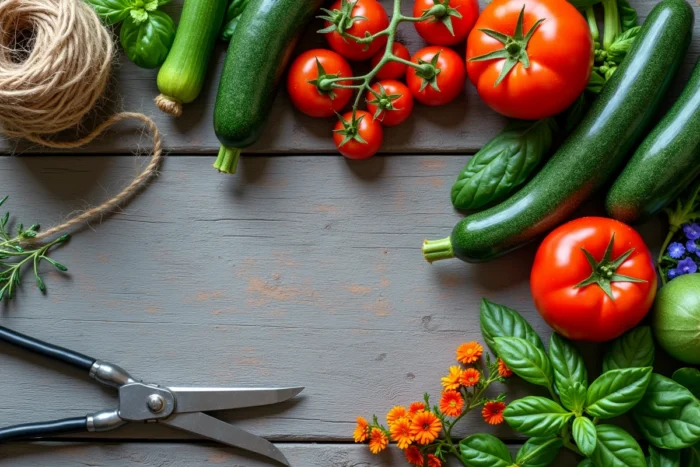
A productive garden is not necessarily a tightly spaced vegetable garden separated from the rest. The combination of edible flowers and vegetables in the same space creates a garden that is both beautiful and useful.
Nasturtiums, marigolds, borage, and cosmos can be integrated between rows of tomatoes or zucchinis. Nasturtiums attract aphids away from the vegetables. Marigolds repel certain soil nematodes. Borage attracts pollinators, which improves the setting of cucurbits.
The main consideration is treatments: no chemical products on a bed where flowers intended for the plate grow. We prioritize plant-based concoctions, diluted black soap, and crop rotation to limit diseases. Maintenance remains simple if the soil was well prepared and mulched at planting.
Edible perennials to limit maintenance
Instead of reseeding every year, we can install edible perennials that come back on their own: chives (decorative purple flowers), creeping thyme (flowering ground cover), lavender (usable in cooking and very bee-friendly). These plants require little water once established and structure the garden even in winter thanks to their evergreen foliage.
A flowering and productive garden rests on three concrete pillars: a soil prepared without brutality, a mulch that works for you, and plants chosen to cover each month of the year. The rest is observation throughout the seasons, noting what works and what deserves to be replaced.