
Between an IPA brewed for a local festival and a permanent stout sold in a gourmet grocery store, the bottle rarely changes. What changes is the label. For a craft brewery, the choice of label format determines the production pace, commercial flexibility, and regulatory compliance. Self-adhesive labels have prevailed over wet glue labels, but the reasons for this dominance deserve to be examined point by point.
Self-adhesive labels vs. wet glue: technical comparison for breweries
Most competitors detail the types of paper or finishes available. Before getting there, it is essential to compare the two main families of application, as this initial choice determines the budget, production speed, and creative leeway.
| Criterion | Self-adhesive label | Wet glue label |
|---|---|---|
| Application | Pre-glued, manual or simple machine application | Requires a dedicated labeling machine |
| Small runs | Cost-effective from a few dozen units | High setup cost, not suitable for several hundred |
| Visual change | Immediate (different roll) | Cleaning the labeling machine, downtime |
| Moisture resistance | Depends on the material (PP, vinyl, laminated paper) | Risk of peeling in humid environments without suitable varnish |
| Deposit/reuse compatibility | Washable adhesives available | Easier to remove with water on bare glass |
| Unit cost in large series | Slightly higher | Lower on large volumes |
The conclusion is clear: wet glue remains competitive only on very large volumes, a threshold that most craft breweries do not reach. As noted by the advice from the site Le Managemental, the flexibility of self-adhesive labels allows for simultaneous management of multiple recipes without immobilizing heavy equipment.
Short-run digital printing: what it changes for craft labeling
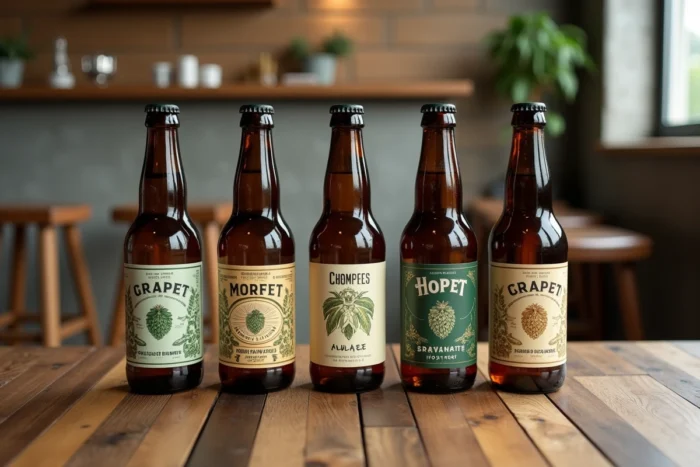
The self-adhesive label would be just a minor logistical gain without the parallel evolution of digital printing. Since 2024, beverage specialty printers have noted an acceleration in demand for highly fragmented runs. A brewery can order a mixed roll containing different labels for each reference (IPA, stout, sour, saison) without additional setup costs.
This micro-personalization transforms the self-adhesive label into a commercial lever. Three concrete use cases illustrate this flexibility:
- Limited editions and occasional collaborations with a local producer or another brewer, where the visual is ephemeral by nature and the run counts in dozens or hundreds of units.
- Testing new recipes, where the brewer needs professional packaging without committing to an offset printing budget for a beer that may not be continued.
- Event co-branding (festivals, Christmas markets, trade shows), which requires specific mentions, a partner logo, or a different expiration date.
However, digital printing does not eliminate all constraints. The quality of rendering on textured papers remains inferior to that of offset for very dense color blocks. A brewer relying on a dark and saturated visual will need to check the rendering before approving a print run.
Environmental labeling and deposit: anticipating regulatory obligations on the label
The Climate and Resilience Law provides for the gradual generalization of environmental labeling for food products, with methodological work ongoing since 2023 for expanded implementation starting from 2025-2026. For craft breweries, this means that additional space must be reserved on the label for an environmental logo, score, or mention.
Self-adhesive labels absorb these regulatory additions better than a traditional gluing system. The reason is simple: modifying a digital print file and ordering a new roll takes a few days. Reproducing offset plates or adapting a labeling machine to a slightly different format takes more time and budget.
The return of the deposit for reuse in the European debate adds an additional constraint. Deposited bottles must be able to be cleaned and relabeled. Washable adhesives are already available on the market, allowing for residue-free removal after passing through an industrial washer. A label that peels off cleanly protects both the bottle and the brewery’s image.
Adhesive materials and resistance: choosing based on the distribution circuit
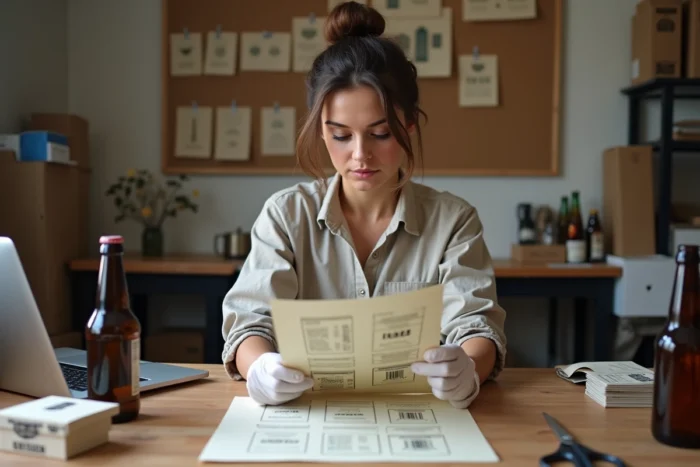
The sales circuit dictates the material much more than the brewer’s aesthetic taste. A bottle sold directly at the farm does not face the same constraints as a bottle stored for several weeks in a refrigerated bin at a wine merchant.
- Coated laminated paper is suitable for short circuits with a quick turnover. It offers good print quality and moderate cost but does not withstand prolonged immersion well.
- Transparent or white polypropylene (PP) withstands moisture, condensation, and temperature variations. It is suitable for breweries whose products go through large distribution or export.
- Vinyl remains the most resistant material to abrasion and solvents, but its cost limits it to specific uses such as kegs or frequently handled event formats.
Polypropylene represents the most common compromise for craft breweries that distribute through multiple channels. It tolerates condensation from a refrigerator door while accepting a decent quality digital print.
Impact of the material on product perception
A textured paper evokes craftsmanship and terroir. Transparent PP gives a modern, almost “label-free” look. The choice is not trivial: the label material influences the consumer’s perception of price. Breweries positioned in a premium segment should test several substrates before finalizing their visual identity.
The self-adhesive label has become established in craft breweries because it simultaneously addresses three pressures: the fragmentation of ranges, regulatory evolution, and the diversity of sales circuits. The real trade-off is no longer about the application format but about the material and printing method, two parameters that depend on the production volume and the commercial positioning of each brewer.