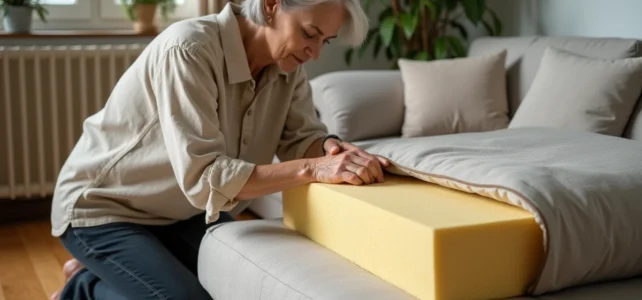
The Poltronesofa sofas that sag after a few years of use regularly fuel consumer forums. Deformed seat cushions, backs that no longer support the back, foam that has become “crepe”: replacing the filling then seems like the logical solution. The manufacturer’s maintenance booklet, the technical constraints of the foam, and the very structure of the sofa impose specific conditions that many individuals discover too late.
Poltronesofa Manufacturer Guidelines: What the Maintenance Booklet Requires Before Any Intervention
The official maintenance booklet of Poltronesofa specifies that certain operations on the internal fillings must be entrusted to customer service or authorized professionals. Intervening oneself can be considered a non-compliant modification, with a risk of losing rights in case of subsequent claims.
This constraint almost never appears in the foam replacement tutorials found online. Most describe a generic procedure (removing the cover, cutting the foam, replacing it) without mentioning that the manufacturer regulates this type of intervention.
Before ordering a replacement foam, the first step is to check if the sofa is still under warranty and whether the intended operation compromises it. When considering replacing the foam of a Poltronesofa sofa, this verification conditions the next steps. Outside the warranty period, the constraint disappears, but it remains a poorly known starting point.

Foam Density for Sofas: The Trap of Confusion with Firmness
Density, expressed in kg/m³, measures the amount of material in a given volume. It determines the lifespan of the foam. Firmness, on the other hand, only concerns the feel: hard or soft.
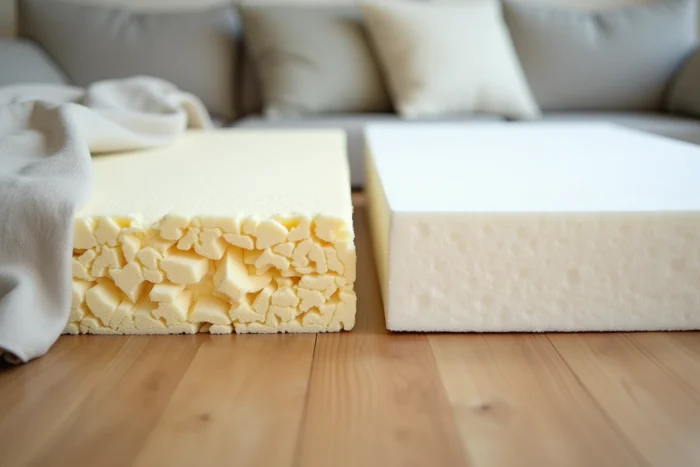
A block of foam may feel firm in the store while having a low density. In this case, it will sag within a few months. The foams used by Poltronesofa in their seats generally fall within a range of 30 to 35 kg/m³. Choosing a replacement foam below this threshold means degrading comfort instead of restoring it.
The Most Common Ordering Mistakes
- Ordering foam solely based on its firmness (hard, medium, soft) without checking the density listed on the technical sheet. Firmness can be identical between a foam at 20 kg/m³ and one at 35 kg/m³, but the latter will last several more years.
- Choosing a uniform density for both the seat and the backrest. The backrest supports less weight and requires a lower density than the seat, or it risks losing the original ergonomic support.
- Ignoring resilience (the foam’s ability to regain its shape). A high-density foam but with low resilience retains impressions permanently after a few weeks.
Ask for the weight per cubic meter, not the feel: this is the only reliable information when purchasing a block of foam, whether online or in a specialty store.
Cutting and Foam Dimensions: Measurement Errors That Ruin the Result
Cutting is the stage where errors are the least recoverable. A block that is too small shifts in the cover and creates unsightly wrinkles. A block that is too thick distorts the seams and puts pressure on the zippers to the point of breaking them.
Poltronesofa sofas use structures with sometimes specific shapes: rounded corners, curves on the armrests, varying thicknesses between the front and back of the seat. Measuring the old foam once removed gives distorted dimensions, as the original foam is already compressed and deformed from years of use.
Reliable Measurement Method
Measure the inside of the cover flat, on a flat surface, taking the dimensions empty. Adding about a centimeter in length and width allows the new foam to fit properly in the cover without leaving any play.
For thickness, the measurement is taken on the structure of the sofa itself (depth of the seat between the bottom and the top edge of the frame), not on the old block. Field feedback varies on this point: some upholsterers recommend increasing the thickness by half a centimeter, while others prefer to keep the exact measurement to avoid overstretching the fabric.
Structure and Frame of the Poltronesofa: Check Before Refilling
Replacing the foam without inspecting the underlying structure is a costly mistake. On consumer forums, several owners of Poltronesofa sofas report that the sagging was not only due to the foam but also to loosened elastic straps or slats that had come loose from the frame.
A new foam placed on a faulty structure will sag just as quickly as the old one. Before investing in replacement filling, turning the sofa over and checking the condition of the base takes five minutes and can prevent having to redo the operation six months later.
- Test the tension of the straps by pressing in the center: if the hand sinks more than a few centimeters, the straps need to be replaced or retightened.
- Check that the wooden frame has no cracks or looseness at the joints, especially on corner sofas that undergo asymmetrical stresses.
- Inspect the staples that secure the straps to the frame: they can pull out of the wood over time, especially if the frame uses lightweight woods.
The Condition of the Fabric or Covering
The covering influences the perception of comfort as much as the foam. A loose fabric gives a feeling of softness even with a new foam of good density. If the cover has lost its elasticity, the replacement foam will not correct the feeling of sagging. For Poltronesofa models with removable covers, checking the condition of the fabric before ordering the foam allows for a decision between a simple filling replacement and a more complete refurbishment.
Replacing foam on a Poltronesofa remains an accessible operation as long as the manufacturer’s specifications are respected, a density at least equivalent to the original is chosen, and the condition of the supporting structure is checked. Skipping any of these steps turns an economical repair into a quick source of frustration.