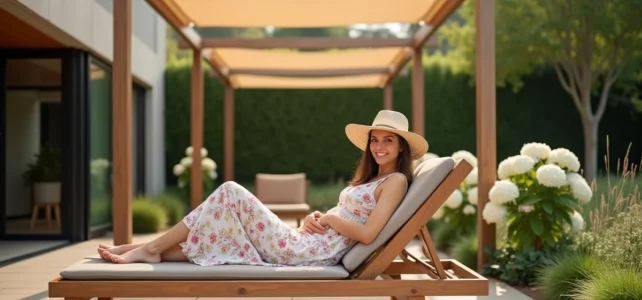
Sunbathing under a pergola means exposing yourself to UV rays without always realizing it. Ultraviolet rays partially penetrate the structure, bounce off light-colored surfaces, and reach the skin even when you think you are in the shade. The question is not whether to choose between direct sunlight and a pergola, but to measure what actually passes through each type of covering and to adjust your protection accordingly.
UV Transmission According to the Type of Pergola Covering
Not all pergolas filter rays in the same way. The covering material, its density, and its opacity determine the amount of UV that reaches the skin. A light-colored surface (beige slab, limestone) further amplifies exposure through reflection.
| Type of Covering | Estimated UV Filtering | Suitable for Prolonged Tanning |
|---|---|---|
| Adjustable bioclimatic slats (aluminum) | Variable depending on the angle of opening | Yes, with regular adjustment |
| Opaque PVC fabric | Very high | No (too much shade) |
| Reed or natural heather | Moderate, diffuse passage | Yes, gentle exposure |
| Woven shade sail | Medium to high depending on weight | Yes if lightweight |
| Translucent polycarbonate | Low to moderate | Slow exposure, risk of overheating |
Reed and heather allow filtered light to pass through, enabling a gradual tan without direct exposure. In contrast, an opaque PVC fabric blocks almost all rays and is not suitable if the goal is to tan.
Bioclimatic slats offer the best compromise: they allow you to control the amount of light entering throughout the day. Their angle of inclination directly modifies the surface area of exposed skin, preventing you from switching between total shade and direct sunlight.
Those who wish to tan in their garden with Ma Maison Idéale will find useful information on choosing the right structure for each terrace configuration.
Pergola Orientation and Sun Path: The Angle That Guides Forget
The orientation of the pergola in relation to the sun’s path radically changes the exposure strategy. A south-facing pergola receives maximum sunlight between late morning and mid-afternoon. An east-facing pergola mainly captures the softer morning light.
South Exposure: Managing Overheating
On a south-facing facade, sun protection must be reinforced between eleven a.m. and three p.m. During this time frame, UV rays are at their highest intensity. Partially closing the slats or deploying an additional shade sail protects the skin without giving up morning or late-day tanning.
East or West Exposure: Shorter Time Slots
An east-facing pergola offers gradual morning tanning, with less aggressive rays. The west exposure, on the other hand, concentrates sunlight in the late afternoon when the low-angle light heats for a long time without always perceiving the burn.
The west orientation is the most deceptive for the skin: the sensation of heat decreases while the cumulative UV exposure remains significant. This is the facade where late-day sunburns are most common.
Sun Protection Under Pergola: What Sunscreen Alone Does Not Cover
Sunscreen remains the foundation, but it has specific limitations in the context of the pergola and garden. Under a semi-open structure, sweating, movement, and swimming (pool, misting) quickly reduce the product’s effectiveness.
- The forgotten areas (ears, tops of feet, neck, around the eyes) are the first to burn under a pergola, as people often settle there without a hat, unlike at the beach.
- Sun sticks and compact formats allow for touch-ups on these sensitive areas without getting up or rinsing hands, which increases the actual frequency of application.
- The cream should be applied about fifteen minutes before exposure for the filters to be active, a delay often ignored when simply stepping out onto the terrace.
- A light-colored surface (stone, concrete) reflects UV rays towards the lower face and legs, even under an opaque covering. A dark outdoor rug reduces this reflection.
The common reflex is not to protect oneself under the pergola because one is “in the shade.” The shade of a pergola reduces the intensity of UV rays without eliminating them, especially if the covering is perforated or if the surrounding ground is light-colored.
Garden Layout for Comfortable and Safe Tanning
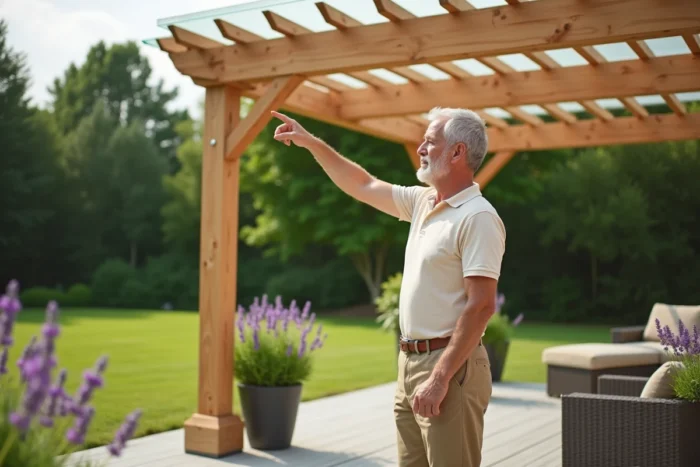
Beyond the pergola itself, the layout of the space around the structure influences the comfort and safety of tanning. Hybrid devices that combine pergola, misting, and adjustable furniture are gaining ground in recent outdoor designs.
Furniture and Positioning
A reclining deck chair allows you to change the angle of exposure without moving. Positioned perpendicular to the slats of the pergola, it captures diffuse light evenly across the entire body.
Placing the deck chair slightly back from the edge of the pergola, rather than in the center, offers a balance between partial shade and filtered sunlight. This shift of a few dozen centimeters significantly varies the amount of light received.
Misting and Hydration
A misting system attached to the pergola posts lowers the perceived temperature without wetting the skin to the point of removing sunscreen. Regular hydration, in parallel, compensates for the water loss that is often underestimated in one’s own garden.
The combination of a bioclimatic pergola, removable shade sail, and misting system creates a modular space where tanning adapts to the time and weather rather than the other way around. This type of installation allows for longer outdoor stays, with controlled exposure throughout the day.
The most common trap remains duration. Under a comfortable pergola, one loses track of the time spent in the sun. Setting an alert every thirty minutes to reassess your position, reapply your protection, and drink is enough to avoid most garden sunburns.