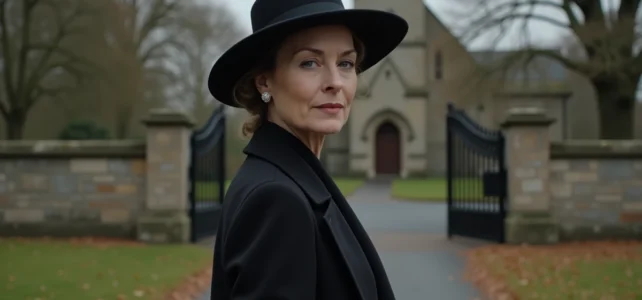
The hat worn at funerals remains an accessory loaded with codes. Few women still adopt it in France, but those who do face a lack of clear guidelines. Between the customs inherited from religious ceremonies and the recent evolution of funeral practices, choosing a hat for a burial requires knowledge of a few unspoken rules, and especially an understanding of which have truly changed.
Face shape and type of hat: what etiquette doesn’t say
Funeral etiquette guides focus on color and sobriety. They almost always overlook a parameter that determines the overall look: the shape of the face guides the choice of model. A hat that is too large on a slender face draws attention, exactly the opposite of the effect sought at a funeral.
For a round face, a model with a high crown and medium brims elongates the silhouette without creating lateral volume. An oval face can support most shapes, including the tambourine or the discreet bibi. Square faces benefit from wearing slightly asymmetrical or rounded brims, which soften the angles of the jaw.
These considerations are not about vanity. A poorly proportioned hat creates a visual discrepancy that captures attention, which goes against the expected discretion. Funeral professionals also remind us that the outfit should blend into the atmosphere of the ceremony, hat included.
To delve deeper into the conventions surrounding the wearing of this accessory, there are detailed resources like a hat for a funeral on Les Humeurs de Gloupsy Chérie that reviews the specific etiquette rules for women.
Funeral ceremony hat: sober models to favor
Not all ceremonial hats are suitable for funerals. The wide-brimmed hat, associated with weddings and horse races, poses a problem in a funeral context: it occupies too much visual space and can obstruct the view of those sitting behind during the ceremony.
Three types of headwear adapt well to funerals:
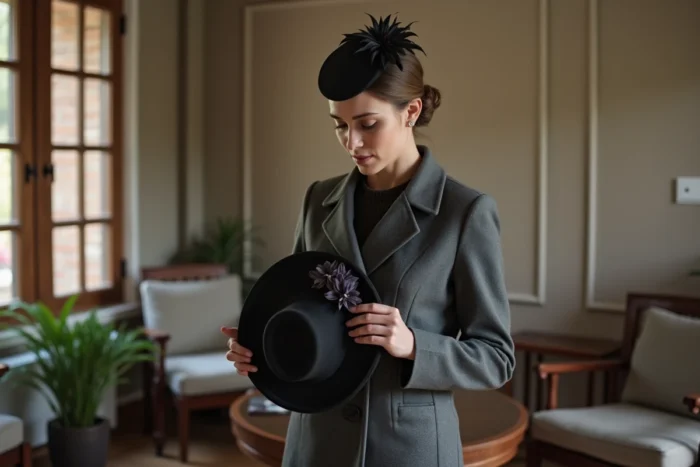
- The tambourine with a flat crown, made of a matte fabric (felt, fine wool), which stays close to the head and does not extend beyond the visual field of others. It adds a structured touch without theatricality.
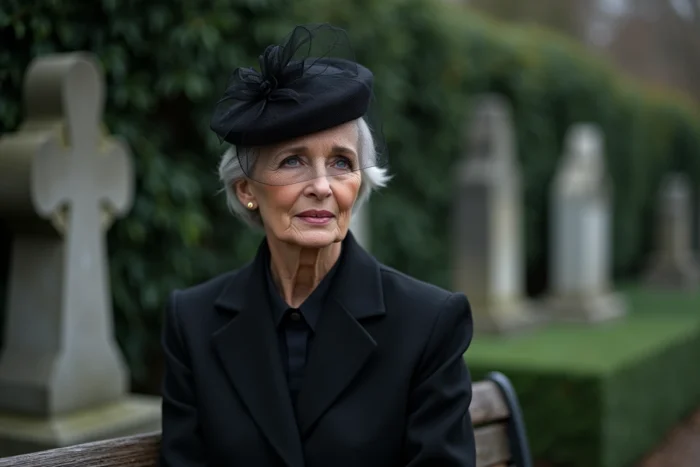
- The bibi, a small hat secured with a clip or comb, sometimes accompanied by a short veil. The bibi with a veil remains the most codified model for mourning, directly inherited from Victorian tradition.
- The short-brimmed felt (bell type or women’s fedora), in black or anthracite gray, which covers without imposing. Its enveloping shape is suitable for outdoor ceremonies where wind can pose a practical problem.
An embellished headband or wide band can serve as alternatives for those who find hats too formal. They signal a dressing intention without the symbolic weight of a full headpiece.
Colors and materials for a women’s funeral hat
Black remains the default norm. However, navy blue, anthracite gray, and dark purple are now accepted in most funeral contexts in France. Purple, in particular, carries a mourning symbolism in several Christian traditions, making it relevant for religious ceremonies.
Shiny or satin materials should be avoided. A matte felt, structured cotton, or sober wool works better than a glossy synthetic fabric that catches the light. The same question arises for embellishments: a discreet brooch or a tone-on-tone ribbon passes without difficulty, while a colored feather or a large flower stands out.
The basic rule can be summed up in one sentence: if the accessory draws attention before the outfit, it is too visible. This principle also applies to the choice of brim size, crown height, and the potential presence of a veil.
When to remove your hat during funerals
The question of removal is divisive because practices vary according to the location and type of ceremony. In a Catholic church, tradition allows women to keep their hats on during the service. This convention, inherited from the historical obligation to cover one’s head in a place of worship, persists in practice even though it has not been mandatory since the 1960s.
During a civil ceremony in a crematorium or hall, no established rule dictates whether to keep or remove the hat. The most common practice is to keep it on during the ceremony and remove it at the time of condolences, to allow direct eye contact with the family.
At the cemetery, the hat is kept on. External conditions (wind, rain, sun) give it a practical function that transcends the symbol. Removing it in these circumstances has no protocol justification.
Special case of multifaith ceremonies
When funerals bring together people from different traditions, experiences on this point vary. Some families explicitly request all women to cover their heads, while others prefer to leave it up to individual choice. In the absence of indication, wearing a discreet hat remains a safe choice that does not offend any sensitivities.
Subtle personalization: what recent funeral practices allow
Funeral professionals increasingly encourage an approach where the outfit respects primarily the wishes of the deceased and their family, rather than a rigid dress code. This evolution translates into a growing acceptance of accessories that carry personal significance.
A hat that belonged to the deceased, a scarf in a color they loved, an inherited brooch pinned to the hat’s ribbon: these gestures of personalization remain subtle while adding an emotional dimension to the outfit. They do not replace the basic codes (dark colors, matte materials, discreet shapes), but they complement them.
The funeral outfit is no longer a strict uniform but a balance between collective respect and personal tribute. The hat, because it is visible, carries this dual function better than most other accessories. Choosing the right model comes down to finding the exact point where discretion meets intention.