
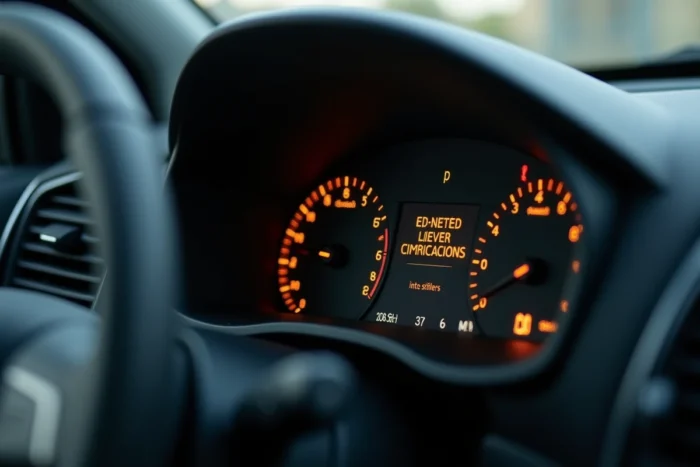
We are cruising smoothly on the highway when the dashboard of the Clio 5 suddenly displays “injection to be checked” accompanied by the orange engine light. The instinct is to wonder whether we can continue or if we need to pull over. The answer depends on a single criterion: the presence or absence of a loss of power.
Without a loss of power, we can reach a garage at a moderate speed. With a sudden deceleration despite pressing the accelerator, we pull over as soon as possible.
What the engine control unit really detects on the Clio 5
The message “injection to be checked” does not indicate a single fault. It signals that the engine control unit (ECU) has detected an anomaly in the chain from the fuel tank to the combustion chamber, or in the pollution control system that processes the exhaust gases. The ECU continuously monitors dozens of parameters: rail pressure, amount of fuel injected, exhaust gas temperature, residual oxygen level.
When a value falls outside the expected range, the ECU records a fault code (OBD format) and triggers the alert on the dashboard. On Renaults, this same message can appear for an injector problem as well as for an issue with the lambda sensor or EGR valve. It is this ambiguity that makes on-site diagnosis essential.
To understand the Clio 5 injection control unit and the logic behind its fault codes, it is helpful to first identify whether the alert is accompanied by a noticeable symptom while driving or if it remains silent.
OBD codes and diagnosis: reading the real fault behind the message
Connecting an OBD scanner to the diagnostic port (under the steering wheel, driver’s side) allows you to retrieve the exact fault code stored by the ECU. Without this step, we are navigating in the dark.
On the Clio 5, the most common codes behind the message “injection to be checked” point to distinct components:
- A code related to injectors (clogging, flow out of tolerance) often indicates a problem with fuel quality or high mileage without cleaning.
- A sensor code (rail pressure, lambda sensor, temperature sensor) indicates a faulty electronic component or an oxidized connector.
- A code for the EGR valve or particulate filter (DPF) points to the pollution control circuit, not to injection in the strict sense.
The nuance matters: replacing injectors when the real problem is a pressure sensor costing a few dozen euros amounts to throwing money away. The OBD diagnosis avoids this trap.
Public OBD scanner or garage visit
Entry-level OBD readers read generic codes (series P0xxx). For Renault manufacturer codes (series P2xxx, P3xxx), a tool compatible with the Renault protocol or a visit to an equipped garage is required. Feedback varies on this point: some low-cost readers already retrieve manufacturer codes on the Clio 5, while others do not.
In any case, note the code, clear the alert, then drive a few kilometers. If the light comes back on, the fault is confirmed and not intermittent.
Common faults on Clio 5: what lies behind the orange light
Competitors readily list five or eight possible causes. In practice, three scenarios occur significantly more often than others on the Clio 5.
Clogged EGR valve
The EGR valve recirculates some of the exhaust gases back to the intake to reduce nitrogen oxide emissions. On short urban trips, it clogs quickly. The ECU detects an abnormal flow and displays the alert. A cleaning of the EGR valve often suffices to resolve the problem, especially on the diesel (dCi) engines of the Clio 5.
Clogged or faulty injectors
Carbon deposits on the injectors alter the fuel spray. Combustion becomes irregular, consumption increases, and the ECU records a flow deviation. A cleaning treatment injected into the circuit can correct light clogging. Beyond that, replacing one or more injectors is necessary.
Faulty sensors or oxidized connectors
A rail pressure sensor sending an inconsistent value, an aging lambda sensor, or simply an oxidized wire at a connector: electronic faults account for a significant portion of injection alerts. The repair cost remains moderate, but the diagnosis must be precise to avoid replacing the wrong part.

Manufacturer recalls and recent engine blocks: check before paying
Not all “injection to be checked” messages are due to normal wear. On certain blocks from the 1.2 turbo family, factory fixes have been deployed since 2024. Before incurring costs, check with the Renault dealership if the vehicle is affected by a recall or an ECU update.
The Eco-G (LPG) versions introduced in the Clio range add a layer of complexity: the injection system manages two fuels, and a fault may originate from the LPG circuit without the gasoline injection being at fault. The diagnosis must cover both circuits.
Checking the history of manufacturer recalls before any intervention can save on repairs sometimes covered by Renault, even outside the standard warranty.
To drive or to stop: the simple rule to remember
The message alone, without loss of power or jolts, allows for cautious driving to the nearest garage. Avoid high revs, stay below 3,000 RPM, and schedule the diagnosis quickly.
If the car loses power, stutters, or if the light blinks instead of remaining steady, we stop. A blinking engine light signals a risk of damage to the catalyst or DPF, and continuing to drive can turn a moderate repair into a hefty bill.
The good habit on a Clio 5 remains to never clear a warning light without having read the OBD code. The code tells what the message does not, and it is what guides the repair in the right direction.