
Daily life with children revolves around repeated micro-decisions: choice of textiles, arrangement of storage spaces, sequencing of routines. We observe that households that gain fluidity do not multiply tools but better calibrate those they already use. The challenge is not to add style superficially, but to integrate visual and functional coherence into every gesture from morning to bedtime.
Integrated digital disconnection protocol in family routines
Since 2024, the notion of total disconnection periods has emerged as a concrete lever to ease daily transitions. The principle: define screen-free slots (dinner, quiet time on weekends) and a physical area of the house where no devices are allowed.
We recommend materializing this area with a simple object, a textile basket or a dedicated shelf, rather than through verbal prohibition. The child associates the place with a ritual, not a punishment. The benefit is measured in the quality of bedtime and the reduction of negotiations around screens.
Retro-parenting, a trend documented in 2025-2026, extends this logic: fixed bedtime, more analog time, no smartphones before middle school. This is not nostalgia; it is a lightened sensory framework that promotes autonomy. A child less solicited by digital stimuli quickly transitions through their morning routine without parental prompting.
To delve deeper into these topics around well-being and daily life, numerous resources exist, particularly on children on the Maman Chic website, which addresses these issues from the perspective of style and practicality.
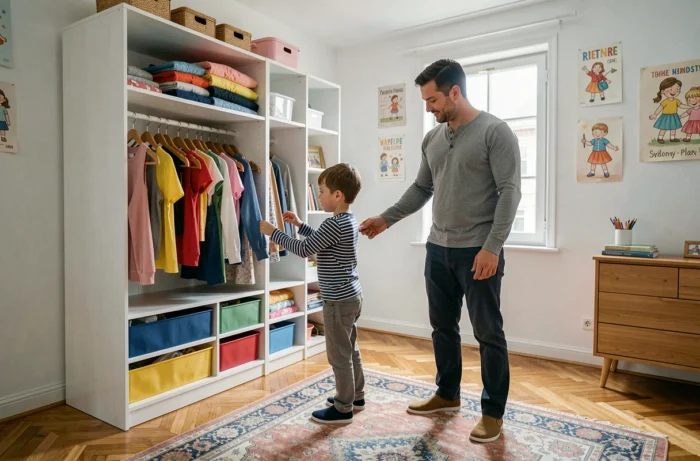
Functional children’s wardrobe: materials, rotation, and clothing autonomy
A children’s wardrobe designed for autonomy relies on three technical parameters: materials resistant to frequent washing, a limited color palette, and physical accessibility of clothing.
Choice of materials and maintenance
Twill cotton and organic cotton jersey hold up better to washing cycles than cheap synthetic blends. A garment that pills after three washes ends up at the bottom of the drawer and complicates the child’s morning choices.
We favor straight cuts without small buttons or complex closures for children under six. The goal: for the child to be able to dress themselves in under five minutes, without help or frustration.
Seasonal rotation and capsule wardrobe
The principle of the capsule wardrobe adapted for children consists of only allowing access to a limited selection of combinable pieces. We observe that about ten tops and the same number of bottoms are more than enough to cover two weeks.
- Systematically remove clothes that are too small or out of season to avoid visual clutter in the closet
- Organize low shelves by category (tops, bottoms, underwear) with illustrated labels for pre-readers
- Provide a “outfit for tomorrow” bin where the child prepares their clothes the night before, integrated into the bedtime ritual
This method reduces parental mental load in the morning. The asymmetry documented by INSEE in the management of household tasks shows that this type of organization primarily benefits mothers, who still bear the majority of children’s clothing logistics.

Designing play and homework spaces at home
A dedicated homework space reduces the time to get to work. The school workstation should not be the kitchen table hastily cleared, but a designated corner with materials stored within reach.
Homework zone: ergonomics and limits
A seat appropriate for the child’s size, direct lighting, and vertical storage for supplies form the foundation. A often overlooked point: the proximity of distractions. A desk facing a shelf of toys sabotages concentration.
We recommend physically separating the zones, even in a small space. A simple curtain or screen is enough to create a visual boundary between the playful universe and school time.
Play corners: toy rotation and aesthetics
The rotation of toys follows the same principle as the clothing capsule. Fewer visible toys, more engagement per toy. By only allowing access to four or five activities at a time, we observe significantly longer independent playtime.
The aesthetics of the play corner also matter to parents. Coordinated fabric bins, open light wood shelves, and a rug delineating the area create a visual coherence that integrates into the living room without turning the space into a toy store.
Emotion management and limits: concrete tools for daily life
Positive education methods have produced an abundance of resources (emotion cards, anger wheels, behavior charts). The issue is not their relevance, but their accumulation. One well-mastered tool is better than five abandoned resources.
We recommend choosing one resource per age group and sticking to it for at least three months:
- For three to five-year-olds, an illustrated emotion card game, used at dinner time to verbalize the day
- For six to eight-year-olds, an emotion thermometer displayed in the bedroom, which the child positions themselves morning and evening
- For nine years and older, a personal notebook where the child writes freely, without imposed parental review
Setting clear limits is part of the daily educational style. No phones in the bedroom after a certain hour, backpack prepared the night before, turning off screens before bedtime: these rules only work if they are consistent and non-negotiable. The regularity of the framework reassures the child more than constant flexibility.
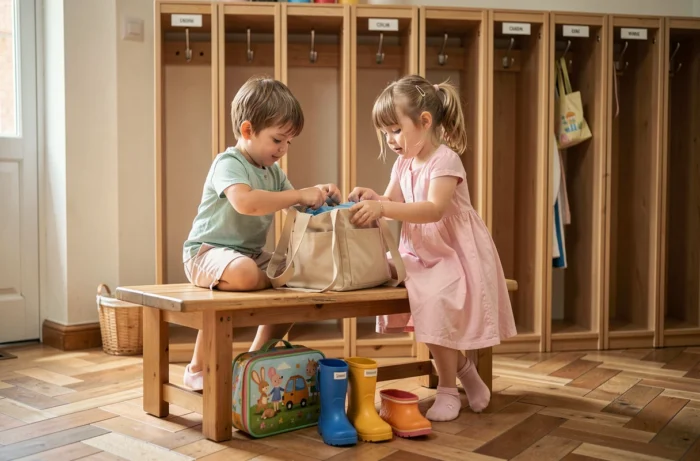
Supporting children’s daily lives with style is fundamentally a question of domestic engineering: each routine, each piece of furniture, each garment serves a specific function. Households that endure over time are those that have reduced the number of decisions to be made each day, not those that have multiplied decorative accessories.