
Between a low-cost wired model and a high-end battery-powered hedge trimmer, the performance gap is not just about motor power. Blade length, tooth spacing, weight in hand, type of cut: these technical parameters determine the quality of the result as much as the comfort of use. Comparing specifications helps to target the electric hedge trimmer suited to the actual configuration of your hedge, without overpaying or under-equipping.
Wired or battery: comparative table of decisive criteria
The choice between a wired hedge trimmer and a battery model is not limited to the question of the cord. Several technical parameters separate these two families, and their differences have a direct impact on daily use.
| Criterion | Wired hedge trimmer | Battery hedge trimmer |
|---|---|---|
| Average weight | Lighter (compact motor) | Heavier (integrated battery) |
| Power | Consistent as long as plugged in | Decreasing towards the end of charge |
| Range | Limited by extension cord | Free, depending on battery life |
| Motor maintenance | Almost none | Almost none |
| Noise level | Low to moderate | Low to moderate |
| Purchase cost | Significantly lower | Higher (battery + charger) |
| Long-term maintenance | No battery to replace | Battery replacement required |
A wired hedge trimmer maintains constant power from the beginning to the end of the session. This is an often underestimated advantage for dense hedges, where branch resistance continuously demands power from the motor. In contrast, the battery model eliminates the constraint of the cord, making it easier to work on long hedges or those far from an outlet.
To delve deeper into the technical characteristics of the various available models, the detailed sheets published on taille-haie-electrique.com allow for comparison of specifications before purchase.
Tooth spacing and cutting capacity: the criterion that power alone does not reveal
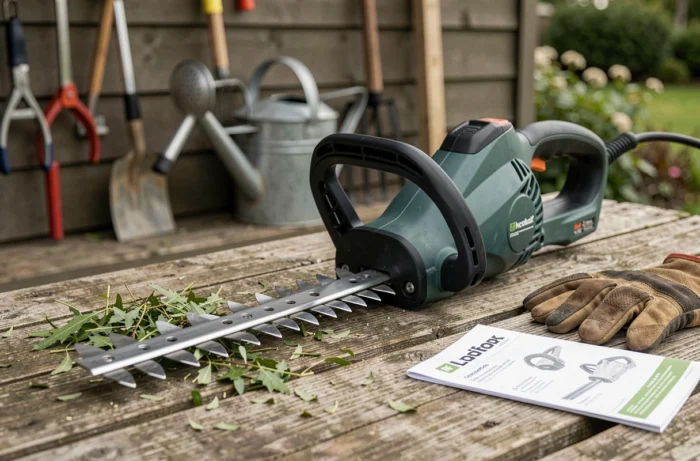
The motor power grabs attention, but the spacing between the teeth of the blade determines the maximum diameter of branches that the hedge trimmer can cut. A model with narrow spacing is suitable for young shoots and regularly maintained hedges. For older, woody branches, a wider spacing is necessary.
The type of cut also plays a direct role in comfort. Double-action blades (both blades move simultaneously in opposite directions) generate less vibration than single-action blades. During an extended trimming session, this difference is felt in the arms and shoulders.
- Privet or laurel hedge trimmed two to three times a year: moderate spacing is sufficient, as the vegetation remains tender
- Mixed country hedge with hardwood species (hornbeam, beech): prefer wide spacing and a double-action blade
- Low decorative hedge (boxwood, yew): a compact model with a short blade offers more precision than a large versatile hedge trimmer
An inappropriate spacing forces the motor and damages the branches instead of cutting them cleanly. The result: poorly healed wounds on the plants, which promote diseases.
Blade length and weight: finding the balance according to your hedge
A long blade covers more surface area with each pass and reduces working time on a large hedge. A short blade offers more maneuverability for complex shapes or finishing touches. The problem is that every additional centimeter of blade adds weight and reduces precision.
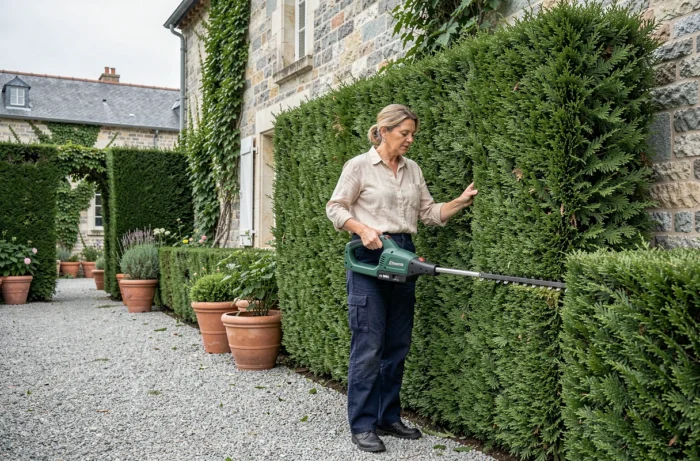
For a tall hedge, the blade length must be related to the physical capacity of the user. A hedge trimmer held at arm’s length for several minutes quickly becomes tiring if its weight exceeds a certain threshold. The rotating handle, present on some models, allows for changing the cutting angle without repositioning the entire body, which relieves strain on high hedges.
Telescopic models (pole hedge trimmers) meet a specific need: reaching the top of a tall hedge without a ladder. Their total length makes them less practical for regular trimming at human height. A pole hedge trimmer complements a classic model; it does not replace it.
European regulations on machines: what changes for electric hedge trimmers
The Regulation (EU) 2023/1230 on machines will replace Directive 2006/42/EC starting January 20, 2027. Any electric hedge trimmer placed on the market after this date must comply with the new text, with no transition period.
The strengthened requirements focus on ergonomics, technical documentation, and safety devices. Manufacturers will need to provide more detailed digital manuals. For importers, the technical file to be kept will be more extensive.
At the same time, the General Product Safety Regulation (EU) 2023/988, applicable since December 13, 2024, requires that a responsible party established in the EU be identified on the product or its packaging, with a risk assessment retained for ten years. For the buyer, the presence of this information on the packaging is an indicator of compliance to check before purchase, especially on marketplaces where some third-party sellers may not yet meet these obligations.
Safety of use: devices to check before purchase
Not all electric hedge trimmers are equipped with the same protections. Three elements deserve systematic verification:
- The two-hand control: the hedge trimmer only operates if both triggers are held down simultaneously, which reduces the risk in case of loss of control
- The front hand guard: a transparent or opaque shell that prevents the hand from slipping towards the blades while in operation
- The blade brake: stopping time of the blades after releasing the triggers, ideally less than one second
The two-hand control is the most crucial safety device on an electric hedge trimmer. Without it, a misstep can have serious consequences. Entry-level models do not always include a quick blade brake: this is a point to examine on the technical sheet.
The French Office for Biodiversity also recommends avoiding hedge trimming from March 15 to July 31, during the nesting period. This calendar conditions the period for purchase and first use for respectful use of local wildlife.